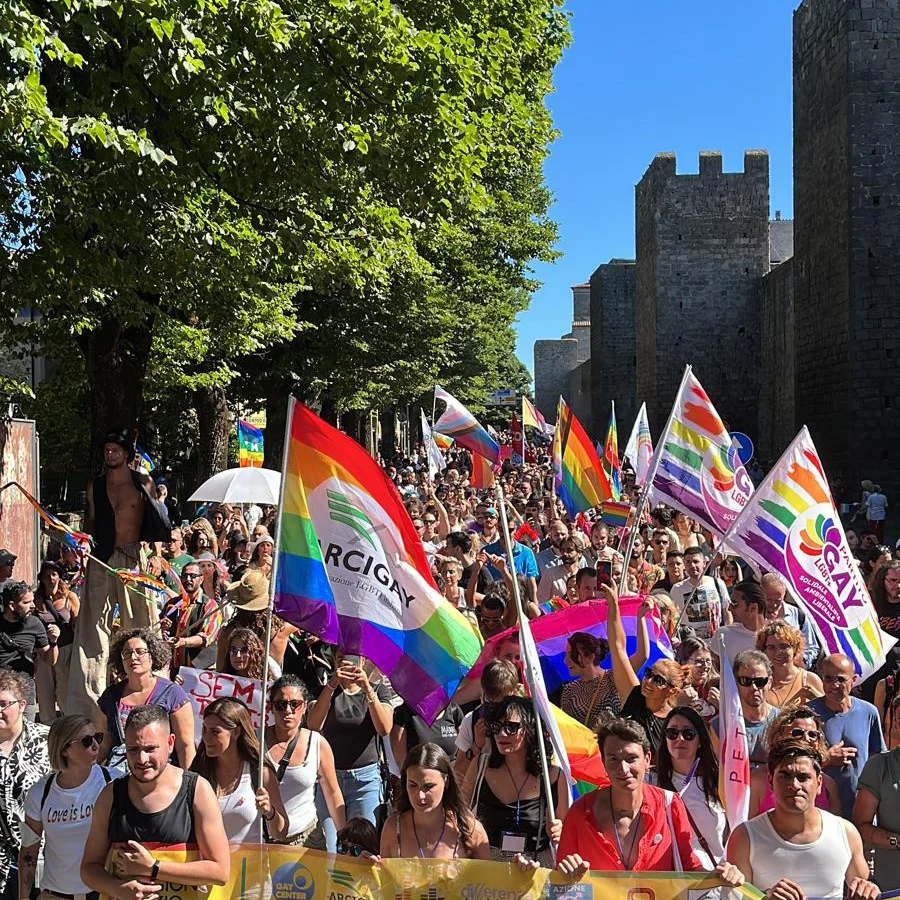
[:en]The response sent to the newspaper is published below My city news which on July 11, 2022 published on its website a reflection of Father Giuseppe Scalella, Prior of the Convent of the Trinity of Viterbo, entitled “About the Lazio Pride in Viterbo…” (link)
Viterbo, July 14, 2022
We begin our response to this startling reflection with a necessary historical background, nourished by the document "Homocausto – The Forgotten Extermination of Homosexuals," published by Arcigay. Discussing World War II in relation to the LGBT+ population means discussing death and oppression during an unspeakable historical period in which the LGBT+ population was dragged alongside other groups equally victimized by hatred. The following information complements the reflection to which we respond.
The number of LGBT+ people arrested under Paragraph 175 during the Nazi regime between 1933 and 1945 was approximately 100,000. Between 10,000 and 15,000 of those incarcerated were later locked up in concentration camps. Of those who were attributed the tragic "pink triangle," historian Rüdiger Lautmann states, a percentage of 60% died, most during the first year of internment. We remind the Prior that the end of the war did not mean any gain in freedom or justice for the LGBT+ community: Paragraph 175, for example, was only repealed in 1994. In Italy, however, the measures were "limited" to issuing warnings, admonitions, or confinement, not to mention the measures adopted outside the law and to which thousands of people were horribly subjected. The Rocco Code adopted by the fascist regime enacted a far more subtle form of discrimination and violence. The absence of explicitly anti-homosexual extermination measures was justified by the fact that envisaging them would have meant admitting the existence of an LGBT+ population in Italy. The Appiani Commission stated: "The provision for this crime is entirely unnecessary because, fortunately and to Italy's pride, the abominable vice that would give rise to it is not widespread enough among us to justify legislative intervention. In appropriate cases, the most severe sanctions relating to rape, corruption of minors, or indecent assault may be applied..." And we are far from living in a period in which the demand for human rights is something to be underestimated or ignored.
As of 2022, according to ILGA Europe (International Association for LGBT Rights – UN), Italy unfortunately continues to rank only 33rd out of 49 European countries in terms of policies dedicated to protecting the human rights and equality of LGBT+ people. The Gay Help Line service reports receiving over 20,000 contacts per year (more than 50 per day) from LGBT+ people who are victims of discrimination, abuse, violence, and stigma. The same service reports a worrying increase in cases of threats, blackmail, mobbing, bullying, cyberbullying, abuse, and violence in Italy, especially among children. The shameful case of Professor Cloe Bianco is one of the latest atrocious examples of this alarming reality.
Facts, not opinions. Statistics, not precepts. Numbers, not ideas. Answer in this vein.
Having completed the necessary introduction, we can more carefully begin a simple examination of the core of the Prior's reflection, overlooking the somewhat incautious comparison between movements advocating the human and civil rights of sexual minorities and alleged "Masonic-Marxist" ideologies. Somehow, the Prior argues, a phenomenon of "depersonalization" has led people to autonomously assert their own identity (it remains unclear why such a claim would be reprehensible).
Quoting from the reflection: “Arbitrarily defining one's identity, sexual or otherwise, is just another way to serve power and continue the work of depersonalization and destruction of the person,” and then, “I don't understand those who flaunt a false idea of their own person and even take pride in it.”.
Hoping to at least contribute to this lack of understanding, we provide below some easily available information from the main national and international institutions and organizations concerned with the issues of humanity, law, minorities, health, and equality.
CItalian Constitution – Fundamental Principles
“Article 3: All citizens have equal social dignity and are equal before the law, without distinction of sex, race, language, religion, political opinion, personal and social conditions.”
RResolution of the European Parliament of 26 April 2007, art. 8
“The European Parliament […] reiterates its call on all Member States to propose laws that overcome the discrimination faced by same-sex couples and calls on the Commission to submit proposals to ensure that the principle of mutual recognition is also applied in this area in order to guarantee freedom of movement for all people in the European Union without discrimination.”
RResolution of the European Parliament of 26 April 2007, art. 10
“The European Parliament […] condemns discriminatory comments made by political and religious leaders against homosexuals, as they fuel hatred and violence, even if they are subsequently withdrawn, and calls on the hierarchies of the respective organizations to condemn them.”
DUniversal Declaration of Human Rights
“Article 1: All human beings are born free and equal in dignity and rights”;
“Article 2: Everyone is entitled to all the rights and freedoms set forth […], without distinction of any kind, such as race, colour, sex, language, religion, political or other opinion […]”
“Article 19: Everyone has the right to freedom of opinion and expression; this right includes freedom to hold opinions without interference and to seek, receive and impart information and ideas through any media and regardless of frontiers.”
It would perhaps be useful to mention the right to personal identity as an inviolable right of the individual. Every person has the right to represent themselves and be represented as they are, free from inaccuracies that might distort their portrayal in the eyes of others. Violation of the right to personal identity, moreover, constitutes damages, a civil tort that justifies a claim for compensation for "any intentional or negligent act that causes unjust harm to another" (Article 2043 of the Civil Code). The right to personal identity is therefore the right to be oneself, against any erroneous attribution of one's personality, and against any intent to distort or misrepresent. Furthermore, it is in the dialectical value between this inalienable right and the right to the news that a path towards inclusive civilization lies. The truth of the facts, the social utility of the news, and the civil form of reporting constitute the determining factors.
We now come to sexual identity, and Law 164 of 1982 (and Legislative Decree 150/11), which protects those in Italy who do not identify with the sex assigned to them at birth, and which is closely linked to the right to mental and physical health, recalling Articles 3 and 32 of the Constitution.
Moving away from the legal sphere, it is important to mention the position of the APA (American Psychological Association), which, regarding civil rights, sexual orientation, and gender diversity, affirms "the equal treatment of persons of all sexual orientations and genders, as well as policies that address disparities in the effectiveness of health outcomes for lesbian, gay, bisexual, or transgender people." The APA itself dedicated its celebrated Division 44 to the topic, a society for the promulgation of an affirmative psychology with respect to sexual orientation and gender diversity.
The OHCHR (United Nations High Commissioner for Human Rights) has long held that discrimination against LGBT+ people violates the human rights principles enshrined in the Universal Declaration of Human Rights.
In November 2014, UNICEF issued a document aimed at eliminating discrimination against children and parents based on sexual orientation and gender identity.
UNESCO itself has called on every nation to work towards creating education systems that address discrimination and exclusion based on sexual orientation, gender identity, gender expression, and sex characteristics.
And many others below, witnesses and examples, which at this point would be long-winded and demeaning to cite.
In conclusion, we hope we have helped fill the gap in understanding that seemed to plague the Prior's reflections. We invite him to contact us so we can collaborate to build that inclusive and caring reality, which we are certain is the goal of any informed citizen, not motivated by dialectics of hatred and exclusion, which are mostly understandable based on ignorance and homosexual, lesbian, and transphobic prejudice, if not objective, cognitive, or intentional difficulties.
Peter Boom – Viterbo LGBT+ – Arcigay Association
[:]