 In addition to being a fundamental area of learning and growth, Unfortunately, school is also the place where prejudice and discrimination can take root to the detriment of those who do not reflect majority or stereotypical social models. LGBTI teenagers they have difficulty finding positive role models to look up to, while are exposed to homophobic and transphobic bullying Added to this is the embarrassment and superficiality with which educational institutions handle the issue. Homophobic and transphobic bullying, in addition to affecting a person's entire identity and private life, is rooted in a general culture that effectively justifies the aggressors, makes the victim feel inherently guilty, and deprives them of allies and resources. The result is a negative impact not only on health and well-being, but also on one's academic career.. Because of this Arcigay is committed to schools with its School Groups, carrying out specific interventions, curricular and extracurricular workshops for bullying prevention and education on otherness, and training for school staff.[:en]In addition to being a fundamental area of learning and growth, Unfortunately, school is also the place where prejudice and discrimination can take root to the detriment of those who do not reflect majority or stereotypical social models. LGBTI teenagers they have difficulty finding positive role models to look up to, while are exposed to homophobic and transphobic bullying Added to this is the embarrassment and superficiality with which educational institutions handle the issue. Homophobic and transphobic bullying, in addition to affecting a person's entire identity and private life, is rooted in a general culture that effectively justifies the aggressors, makes the victim feel inherently guilty, and deprives them of allies and resources. The result is a negative impact not only on health and well-being, but also on one's academic career.. Because of this Arcigay is committed to schools with its School Groups, carrying out specific interventions, curricular and extracurricular workshops for bullying prevention and education on otherness, and training for school staff.
Programs and initiatives:
[:]
Read more on the topic
School is one of the most demanding and challenging experiences of the transition to adulthood: it is the period in which each individual forges their own identity (personal, social, sexual, moral, political, etc.), responsibilities increase, new relationships are established between self, family, and peers, and multiple transformations, choices, and challenges typical of developmental age are faced. For the first time, we perceive ourselves as social actors, called upon to positively address the developmental challenges we learn through interaction with society. It is in this phase and in this context of life that homophobia and transphobia can have, and often do, a critical and devastating impact on the growth of LGBTI youth. Since its founding, Arcigay has devoted significant attention, both nationally and locally, to schools due to the fundamental role they play in the well-being of LGBTI people and in the country's overall civic growth.
The risk of homophobia and transphobia at school
In addition to being a fundamental learning environment, school is often, unfortunately, also a place where prejudice and consequent discrimination can easily take root against all those who do not conform to widely accepted social models and conform to stereotypes. Therefore, it is a place where LGBTI people can experience significant challenges due to a social environment where they do not feel free to be themselves. At the same time, even students who tend to discriminate against those they perceive as "different" have the right to educational intervention to change their negative attitudes and participate in building a safe and welcoming environment for all.
24% of LGBTI respondents in the 2011 ISTAT research on the homosexual population in Italian society declared having been discriminated against in the school and/or university environment, compared to 14.2% of heterosexual respondents.. A 2012 study by the European Human Rights Agency shows that 55% of young people (18-24) hid their LGBTI identity at school, while only 71% of young people (18-24) lived openly in that context. This is a better figure than for those who went to school many years earlier (the higher the age group, the more people reported hiding their LGBTI identity at school), but it still indicates a significant difficulty.
LGBT adolescents, in particular, face difficulties in finding reliable information and positive role models, while also being easily exposed to homophobic and transphobic attitudes both in school and extracurricular contexts (family, peer groups, sports clubs, etc.). Added to this is the embarrassment and superficiality with which educational institutions and the mass media often deal with these issues, which pushes LGBTI girls and boys (or those perceived as such) to see themselves as extras in their own relational lives.
Homophobia and transphobia at school not only impacts the general health and psychological well-being of LGBTI young people, but above all their academic (and consequently also work) careers, with a high risk of dropping out or performing less well than normal.
Homophobic and transphobic bullying at school
Bullying is that specific phenomenon of bullying between peers, which is exercised in a persistent and organised way according to a specific relational script to the detriment of one or more schoolmates who have no possibility of defending themselves due to the imbalance of power between the attacked and the aggressor.. Unlike aggressive behavior motivated by the specific relationship between two individuals, bullying has a strong social and collective characteristic, because it is deliberately perpetrated by "bullies" in front of other followers, supporters, or more or less silent spectators, with the aim of underscoring their power and dominance. It can be said that bullying puts into practice, without the need for any elaboration to justify it, the discrimination and stigmatization present in society: for bullies and their followers, in fact, the fact that LGBTI people are "repugnant" and "unnatural" requires no theory or demonstration, but is assumed in a non-rational way simply through the example of their peers.
While it's true that bullying typically targets various stigmatized "categories" beyond LGBTI people (fat people, women, and members of ethnic minorities), homophobic and transphobic bullying is unique. On the one hand, it attacks not only the individual because they are LGBTI or presumed to be, but also involves the entire private and personal dimension of their sexuality. On the other, it is rooted in a general culture that is still homophobic and transphobic, which effectively justifies the aggressors and is often internalized by the victim themselves. This aggravates the situation in three main ways:
- the aggression is kept to oneself: on the one hand, others are less receptive due to widespread homo-transphobia and tend to underestimate or blame the victim, on the other hand, the victim himself may find it particularly difficult to ask for help from adults, parents or peers, because this would be equivalent to drawing attention to his own sexuality and identity which he may still be "coming to terms" with in managing shame, anxiety and other people's expectations regarding his heterosexuality or gender conformity;
- Finding support and protection among peers is more difficult: "defending" peers, who are already few in normal situations of other types of bullying, are further reduced in homophobic and transphobic situations because defending a homosexual or transgender person carries the high risk of being associated with them as homosexual or "abnormal," with the consequent extension to oneself of the treatment and gossip reserved for the original victim (this is the typically "contagious" nature of sexual stigma).
- Internalized homophobia increases the victim's vulnerability: the already difficult journey of self-discovery and self-definition makes the person vulnerable to attacks, but this situation worsens when homo-transphobia is internalized by the victim to the point of even making them adopt an attitude of justifying the aggressor and punishing themselves.
According to the Schoolmates study of a sample of high school students in Bologna and Modena in 2005/2006, more than 50% of students had frequently heard homophobic insults at school and had seen homophobic graffiti, particularly targeting gay men. This figure was lower than that for female homosexuality. Overall, male homosexuality was more prevalent, with 15% of students reporting having witnessed the exclusion or isolation of gay or suspected gay boys, and 14% reporting having witnessed acts of verbal or physical aggression. A subsequent research by Arcigay in 2010 on homophobic bullying (commissioned by the Ministry of Social Policies) on more than 800 students in a representative sample of high schools, two thirds of the students reported having heard homophobic insults in the last month at school or teasing towards gay or presumed gay boys, one student in 8 had witnessed sexual harassment, graffiti on walls or threats of physical aggression, and one in 13 had witnessed physical aggression for this reason.. In this case, too, it was primarily male homosexuality that was targeted. Nearly 41% of students were victims of homophobic and transphobic bullying in the last month considered: at the time, considering the student population at that time, one could have spoken of 100,000 victims of homophobic and transphobic bullying in Italy.
It should be noted that during the research that Arcigay conducted on homophobic bullying, the 50% of the selected schools (especially in the south and north-east) refused to collaborate even just for the data collection, which says a lot about the cultural and institutional delay in which the association still finds itself operating. (and young LGBTI people living) in Italy, currently exacerbated by the misinformation propaganda of the so-called “anti-gender” homophobic and transphobic movement.
Arcigay School Groups and intervention programs/projects in schools
For these reasons, with a view to combating all forms of discrimination against LGBTI people in schools and promoting the development of a more open, secular, and inclusive society, Arcigay has been working in schools for 16 years through its School Groups, carrying out specific interventions and actual curricular and extracurricular workshops to prevent bullying and educate about otherness, as well as training school staff.
The primary goal of our interventions and programs is to contribute to creating an inclusive, multicultural school environment that is open to all forms of diversity.
The objectives of Arcigay's interventions in schools are:
- supply the tools for relating to all types of otherness;
- contribute to the expansion of relational skills with oneself and with others;
- supply accurate information about sexual orientation, gender identity and gender roles;
- involve students in bullying prevention;
- provide tools for the analysis of stereotypical representations;
- supply tools for deconstructing representations of various sexual identities;
- explore issues of gender, corporeality, and sexual orientation;
- to favor gaining perspectives on the influence of such representations of the individual and the person, placed in an intersubjective perspective, or included in a community;
- to favor the acquisition of analytical tools for understanding the intentionality of languages, of different expressive registers, of any mass media incompleteness;
The methodologies we use at school
The methodologies are usually characterised by highly interactive methods, thanks also to the use of’non-formal education, which is an individual and group educational activity aimed at improving skills and abilities outside of the formal curriculum (examples: brainstorming, small-group work, simulations, games, life stories, and firsthand accounts). During the workshops, teaching materials are distributed for use in the classroom and/or for independent work, such as bibliographies, filmographies, annotated discographies, terminology glossaries, literary and audiovisual materials.
All training courses are divided into several meetings lasting approximately two hours each., from to be included in the usual daytime teaching activities, or to be carried out as an additional extra-curricular afternoon activity. At the end of the courses, a feedback phase is planned through short questionnaires or plenary discussions. Some courses also include follow-up activities. peer education, during which workshop participants experience a peer mediation role within the classroom regarding the content learned during the course. The peer education activities and experiences will then be verified and self-evaluated by the participants.
When it's not possible to activate training courses, Arcigay, also through collaboration with student organizations, tries to at least carry out interventions in less structured contexts, typically such as assemblies organized by students.
For more information on routes and availability:
Do you want to become a school volunteer? Search here the member association closest to you to find out if it has a school group or intends to form one, and thus be involved, or write to [email protected] if you don't get a response from the local association.
Materials
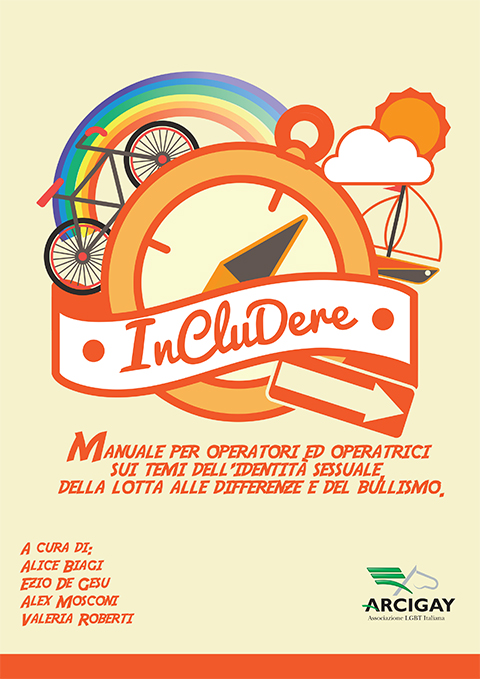
Project Include. A manual for professionals on issues of sexual identity, combating differences, and bullying + quantitative research on homophobic bullying.
AUTHORS: Ezio De Gesu, Alice Biagi, Alex Mosconi, Valeria Roberti, Giulia Selmi.
GRAPHIC DESIGN: Vincenzo Palombino
INFO: The Includere project, funded by the Emilia-Romagna Region, aimed to develop a unified training program for educators, activists, and volunteers working in schools and educational settings. This included specific interventions aimed at preventing homophobia and strengthening inclusive attitudes toward sex and gender. The manual provides information on correct terminology related to bullying and sexual identity and presents useful thematic factsheets for designing and implementing school workshops.
Backpacks on! A handbook for professionals on issues of diversity education and homophobic bullying in schools.
PUBLISHER: Arcigay, 2010
TEXTS: Fabio Saccà, Matteo Martelli, Ambra Guarnieri, Marco Coppola
GRAPHICS: Emilia Franchini – ef9hi.org
SCIENTIFIC SUPERVISOR: Gabriele Prati
PROJECT MANAGERS: Marco Coppola, Fabio Saccà
INFO: The knowledge acquired by Arcigay over 20 years forms the basis of the numerous training activities conducted by the association, which have the primary objective of informing, raising awareness, and promoting education on respect for differences related to sexual orientation. This manual explains our educational approach, based on non-formal methodologies, and is intended for all staff members of organizations and associations working in schools, regardless of their level of experience in leading groups or workshops in schools, who wish to address the issue of homophobic bullying.
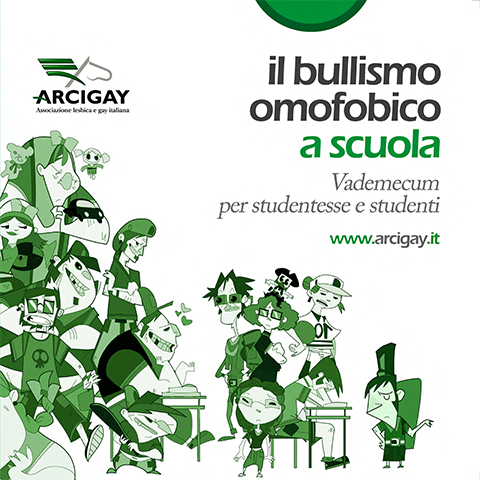
Homophobic Bullying at School: A Handbook for Students
PUBLISHER: Arcigay, 2010
TEXTS: Gianluca Paudice, Fabio Saccà
GRAPHICS: Giacomo Guccinelli
SCIENTIFIC SUPERVISOR: Gabriele Prati
PROJECT MANAGERS: Marco Coppola, Fabio Saccà
INFO: This booklet is about us, boys and girls. We invite you to browse it. School isn't just a place to learn, it's also a place where we meet "others" and learn to be with them. Along this journey, we'll discover many things we have in common, as well as things that make us different. This booklet is about precisely this: what makes us similar and what makes us unique. On the one hand, riches enrich us, but on the other, they can also distance and discriminate us. It all depends on how much we put ourselves out there and try to get to know ourselves better...
Final report of the national research on homophobic bullying in Italian high schools.
PUBLISHER: Arcigay, 2010
TEXTS: Gabriele Prati, Marco Coppola, Fabio Saccà
GRAPHICS: Emilia Franchini – ef9hi.org
SCIENTIFIC SUPERVISOR: Gabriele Prati
PROJECT MANAGERS: Marco Coppola, Fabio Saccà
INFO: Before this research, there were no data in Italy that could provide an idea of the prevalence of homophobic bullying. This research project investigated the presence and types of homophobic bullying in Italian schools, collecting case studies of homophobic bullying incidents and studying homophobia among students and school staff.
We also identified the terminology used by Italian students to denigrate gays and lesbians, obtaining data on the behaviors implemented by school staff in cases of homophobic bullying.
To this end, two studies were conducted: one qualitative study aimed at investigating the forms of homophobic bullying experienced by victims by collecting case studies, and the other quantitative study aimed at identifying the prevalence of homophobic bullying in Italian schools.
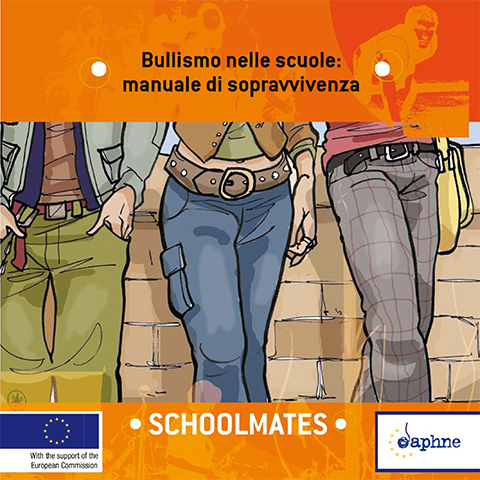
Bullying in Schools: A Survival Guide
PUBLISHER: Arcigay, 2008
AUTHORS: Miles Gualdi, Matteo Martelli, Wolfgang Wilhelm, Robert Biedron’
ILLUSTRATIONS: Giulia Argnani
GRAPHIC DESIGN: ef9hi.org
PRINTING: Negri Typography
INFO: This booklet is designed for young people to provide information, ideas, and practical suggestions on bullying. We will focus specifically, but not exclusively, on homophobic bullying (that is, violence against those who are or are perceived to be homosexual). However, the interactions between bullies and those who suffer their violence are the same regardless of the reasons they use to justify their behavior (homophobia, racism, sexism, anti-Semitism, etc.). Therefore, the advice we offer is useful in all situations.
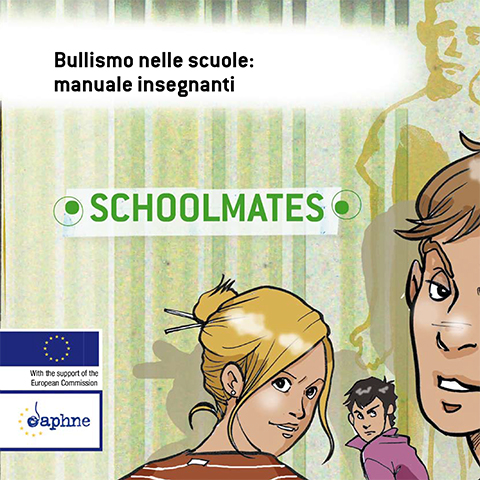
Bullying in Schools: A Teacher's Guide
PUBLISHER: Arcigay, 2008
AUTHORS: Miles Gualdi (Arcigay Italia), Matteo Martelli (Arcigay Italia), Wolfgang Wilhelm (WASt City of Vienna, Austria), Robert Biedron' (Kampania Przeciw Homofobii, Poland) based on material produced by Margherita Graglia (psychotherapist), Luca Pietrantoni (psychologist, University of Bologna)
INFO: The Schoolmates Project is an initiative by Arcigay, the Anti-Discrimination Office of the City of Vienna, the Polish association KPH (Campaign Against Homophobia), and the Spanish NGO Colegas. The project was co-funded by the European Commission under the Daphne II program. The project's goal is to provide school staff and students with tools and skills to help prevent or manage psychological, verbal, or physical violence against anyone who is the target of bullying.
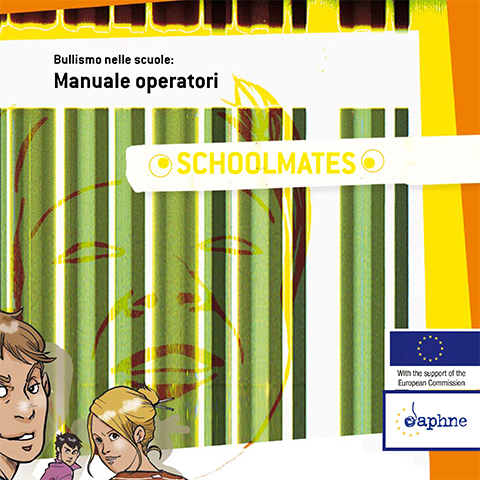
Bullying in schools, operators' manual
PUBLISHER: Arcigay, 2008
AUTHORS: Emanuele Pullega, Miles Gualdi (Arcigay Italy), Matteo Martelli (Arcigay Italy), Wolfgang Wilhelm (WASt City of Vienna, Austria)
ILLUSTRATIONS: Giulia Argnani, ef9hi.org
GRAPHIC DESIGN: ef9hi.org
PRINTING: Negri Typography
INFO: Between 2006 and 2008, Arcigay organized seven anti-bullying workshops in high schools in Bologna, Modena, and Reggio Emilia as part of the European Schoolmates project, of which it was the initiator and leader. At the same time, the project's partner organizations organized and tested the same workshops in schools in Madrid, Warsaw, and Vienna. With this publication, we aim to make the tools, exercises, and materials we used in the classroom available to all professionals, so that anyone interested can replicate them.
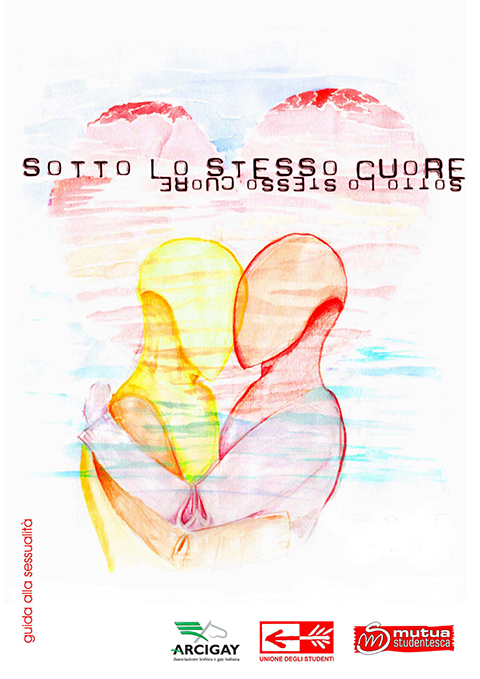
Under the same heart
PUBLISHER: if, sd.
AUTHORS: Fernando D'Aniello, Fabio Saccà
ILLUSTRATIONS: Macaione Angela
PHOTOGRAPHS: Arcigay
COVER AND GRAPHIC DESIGN: Filippo Riniolo
INFO: A booklet for students and young people on sex and sexuality. It contains expert information on prevention, contraception, and sexual orientation, as well as a quick sex education manual, written by students for students, free of bias and covering all orientations.
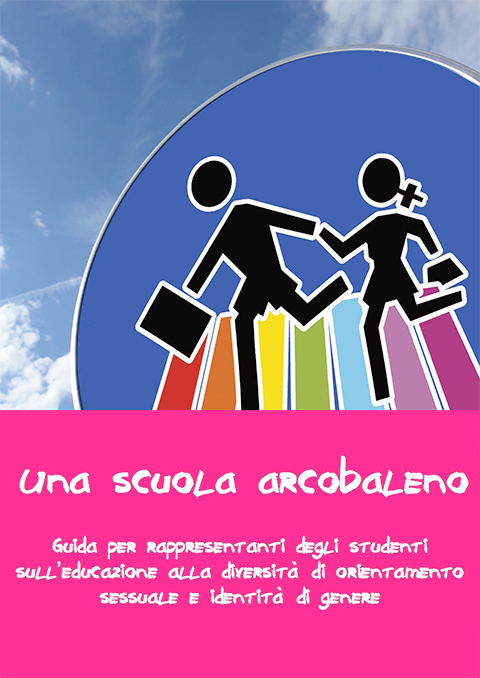
A rainbow school
PUBLISHER: Arcigay, 2007
AUTHORS: Fabio Astrobello, Simone Corsi, Fabio Saccà, and Lorenzo Trapani
INFO: Since June 2007, the Arcigay Youth Network and the national student associations Rete Degli Studenti, Studenti di Sinistra, Unione degli Studenti, and Unione degli Universitari have committed to cooperating on projects to improve the social inclusion of lesbian, gay, bisexual, and transgender (LGBT) students. This guide is aimed at Italian high school students and their representatives. It contains some key recommendations for promoting educational opportunities within schools dedicated to LGBT issues, bullying, homophobia, and diversity in general.