LGBTI people are often subjected to homophobia, biphobia, and transphobia. These terms broadly encompass a range of discriminatory, stigmatizing, and violent attitudes, actions, and discourses toward LGBTI people based on their sexual orientation or gender identity. Homophobia is the fear and aversion towards gay, lesbian, and bisexual people, often including the fear of being perceived as such, which manifests itself in avoidance and rejection of people or situations involving homosexuals. Biphobia, on the other hand, is an aversion to bisexual people, driven by negative stereotypes, such as the belief that bisexuality doesn't exist and the image of bisexual people as promiscuous and unreliable. Transphobia, on the other hand, is an aversion to transsexual and transgender people, stemming from prejudice and stigmatization specifically related to gender identity.
Homophobia and transphobia in Italy
The report on homophobia and transphobia in Italy, published by Arcigay every May 17 (International Day Against Homophobia), showed that in one year between 2015 and 2016, 107 homophobic and transphobic incidents were reported in the Italian press, including two murders and two suicides. This is obviously the tip of the iceberg, as it only concerns events that make the headlines. Homophobia and transphobia, however, manifest themselves in a subtle and constant way in everyday life, because society normally assumes that all people are heterosexual and that homosexual or transgender people do not exist. This is why the more visible LGBTI people are and the more they choose to no longer hide (not "pass as" heterosexual) their identity, the greater their risk of being a victim of homophobia and transphobia and of being targeted by a wide range of reactions from others: rejection, ridicule, bullying, violence, jokes, discrimination in various life contexts: at work, in the family, among acquaintances, etc.
Based on the’European Eurobarometer survey of 2015 Among the general population, the vast majority of Italian respondents stated that discrimination against homosexuals (73%) and transgender people (71%) is widespread in Italy (58% is the European average). Moreover, of this same sample, only 39% stated they were completely comfortable with the possibility of their son or daughter having a homosexual relationship, only 42% stated they were comfortable seeing affectionate gestures between gays in public (73% were comfortable with the same gestures between heterosexuals), and only 26% stated they were comfortable with the possibility of their son or daughter having a relationship with a transgender person. In turn the’2012 European Union Agency for Human Rights (FRA) investigation on a sample of LGBTI people, showed how 96% of respondents in Italy believed that derision and jokes towards LGBTI people in everyday life were very or fairly widespread, 91% believed offensive homophobic or transphobic language was widespread, 79% believed expressions of hatred or aversion were widespread, and 69% believed episodes of violence were widespread. Consistently, only 1% believed it was common for gay people to walk hand-in-hand in public (compared to 83% regarding the same behavior among heterosexuals) in Italy, 39% declared they completely hide their identity at work, and 69% at school. Only 11% allowed themselves to be openly themselves with all their coworkers or classmates. 24% had been treated with less respect in the last 6 months because of their sexual orientation or gender identity. According to Arcigay's 2010 research "Io sono io lavoro" on LGBTI people in the workplace, 13% declared having had a job application rejected on the basis of their sexual orientation or gender identity, over a quarter completely hide their identity at work, 19.1% have been treated unfairly in the workplace in the last 10 years, 4.8% have been fired (and they are mostly trans people)..
Since its founding, Arcigay has been committed to combating and eliminating all forms of discrimination against LGBTI people, fighting against all stereotypes and promoting a culture of understanding and respect at all levels of society. Although homophobia is based on unscientific concepts, it is a concrete and deeply rooted form of thought that has a significant impact on the lives and health of LGBTI people.
Institutions, the State and homo-transphobia
According to the 2015 report by ILGA (an NGO committed to the protection of human rights), the situation in Italy is particularly serious: Out of 49 nations examined, ours is in 34th place, losing two positions from the previous year, in terms of respect for the rights and full equality of LGBTI people., at a level slightly higher than Lithuania and Poland, and lower than Romania and Bulgaria. It's no coincidence that the FRA research cited above showed that LGBTI people, particularly in Italy, believe that greater institutional and public commitment to combating homophobia and transphobia would significantly improve many aspects of daily life, such as work, school, etc.
For years, Arcigay has been working to ensure that homophobia is recognized as a crime in Italy., to ensure that those who commit this heinous crime are prosecuted, and to promote a culture of respect, secularism, and freedom to live one's emotional and sexual life for all. Furthermore, the association maintains ongoing collaboration with Italian institutions that monitor the improvement of the climate for LGBTI people and reduce discrimination and homo-transphobia: UNAR (National Office Against Racial Discrimination – Presidency of the Council of Ministers) and OSCAD (Observatory for Security against Discriminatory Acts – State Police).
The Organized Homo-Transphobia of the Anti-Gender Galaxy
For several years now, organized groups have been active in Italy and Europe, under the umbrella of an "anti-gender" movement and initiative (fighting what they call "gender"), actively opposing any form of inclusion and openness in civil society and institutions toward LGBTI people. This diverse movement, fundamentally religious and ultraconservative, prefers to "hide" its ideological origins by claiming to be "non-denominational," even though its arguments consistently draw on a religious worldview.
In opposing the rights and equality of LGBTI people, this movement has long spread ideas that fundamentally discredit the right to exist of LGBTI people, with arguments ranging from the unnaturalness of the identity and reality of homosexual or transgender people, to their opposition to God's plan for humanity, to feared conspiracies by supposed LGBTI lobbies to confuse and mislead the minds of young people. Drawing on a wealth of manipulation and distortion of the arguments typically used to promote respect for diversity and combat homophobic and transphobic violence, these individuals are highly active in spreading at times paranoid fear-mongering among families and the general population, interfering with the already limited prevention efforts against homophobic and transphobic bullying in schools, and pressuring public institutions to do nothing to improve the lives of LGBTI people.
Arcigay's commitment
Since the homo-transphobic phenomenon is very vast, recently also organized around the anti-gender movement, Arcigay seeks to act on multiple levels, within its available resources. Locally, through its local associations, it is deeply committed to providing psychological and legal support to those affected by homophobia, while at the national level it focuses on preventing the phenomenon through all channels and tools currently available: from training to information, from outreach and research to awareness-raising and communication campaigns. Because data is the starting point for analyzing the phenomenon and combating it,, Arcigay also collaborates with OSCAD, the Observatory for Security against Discriminatory Acts established by the State Police and publishes an annual report on the issues of discrimination and homophobia.
Since 2007, the European Union has established a day against homophobia, biphobia, and transphobia, held on May 17th. Each year, Arcigay organizes numerous activities and communication campaigns throughout the country. Learn more »
Programs and projects:
Responding to the “gender paranoia” in ItalyThis is a project analyzing the ideology, impact, and modes of action of the anti-gender movement in Italy. The project, coordinated by Arcigay, brought together several LGBTI organizations at the national and local levels.
Are you a victim of homophobia or do you know someone who is struggling? Contact the office closest to you [:en]LGBTI people are often subjected to homophobia, biphobia, and transphobia. These terms broadly encompass a range of discriminatory, stigmatizing, and violent attitudes, actions, and discourses toward LGBTI people based on their sexual orientation or gender identity. Homophobia is the fear and aversion towards gay, lesbian, and bisexual people, often including the fear of being perceived as such, which manifests itself in avoidance and rejection of people or situations involving homosexuals. Biphobia, on the other hand, is an aversion to bisexual people, driven by negative stereotypes, such as the belief that bisexuality doesn't exist and the image of bisexual people as promiscuous and unreliable. Transphobia, on the other hand, is an aversion to transsexual and transgender people, stemming from prejudice and stigmatization specifically related to gender identity.
Homophobia and transphobia in Italy
The report on homophobia and transphobia in Italy, published by Arcigay every May 17 (International Day Against Homophobia), showed that in one year between 2015 and 2016, 107 homophobic and transphobic incidents were reported in the Italian press, including two murders and two suicides. This is obviously the tip of the iceberg, as it only concerns events that make the headlines. Homophobia and transphobia, however, manifest themselves in a subtle and constant way in everyday life, because society normally assumes that all people are heterosexual and that homosexual or transgender people do not exist. This is why the more visible LGBTI people are and the more they choose to no longer hide (not "pass as" heterosexual) their identity, the greater their risk of being a victim of homophobia and transphobia and of being targeted by a wide range of reactions from others: rejection, ridicule, bullying, violence, jokes, discrimination in various life contexts: at work, in the family, among acquaintances, etc.
Based on the’European Eurobarometer survey of 2015 Among the general population, the vast majority of Italian respondents stated that discrimination against homosexuals (73%) and transgender people (71%) is widespread in Italy (58% is the European average). Moreover, of this same sample, only 39% stated they were completely comfortable with the possibility of their son or daughter having a homosexual relationship, only 42% stated they were comfortable seeing affectionate gestures between gays in public (73% were comfortable with the same gestures between heterosexuals), and only 26% stated they were comfortable with the possibility of their son or daughter having a relationship with a transgender person. In turn the’2012 European Union Agency for Human Rights (FRA) investigation on a sample of LGBTI people, showed how 96% of respondents in Italy believed that derision and jokes towards LGBTI people in everyday life were very or fairly widespread, 91% believed offensive homophobic or transphobic language was widespread, 79% believed expressions of hatred or aversion were widespread, and 69% believed episodes of violence were widespread. Consistently, only 1% believed it was common for gay people to walk hand-in-hand in public (compared to 83% regarding the same behavior among heterosexuals) in Italy, 39% declared they completely hide their identity at work, and 69% at school. Only 11% allowed themselves to be openly themselves with all their coworkers or classmates. 24% had been treated with less respect in the last 6 months because of their sexual orientation or gender identity. According to Arcigay's 2010 research "Io sono io lavoro" on LGBTI people in the workplace, 13% declared having had a job application rejected on the basis of their sexual orientation or gender identity, over a quarter completely hide their identity at work, 19.1% have been treated unfairly in the workplace in the last 10 years, 4.8% have been fired (and they are mostly trans people)..
Since its founding, Arcigay has been committed to combating and eliminating all forms of discrimination against LGBTI people, fighting against all stereotypes and promoting a culture of understanding and respect at all levels of society. Although homophobia is based on unscientific concepts, it is a concrete and deeply rooted form of thought that has a significant impact on the lives and health of LGBTI people.
Institutions, the State and homo-transphobia
According to the 2015 report by ILGA (an NGO committed to the protection of human rights), the situation in Italy is particularly serious: Out of 49 nations examined, ours is in 34th place, losing two positions from the previous year, in terms of respect for the rights and full equality of LGBTI people., at a level slightly higher than Lithuania and Poland, and lower than Romania and Bulgaria. It's no coincidence that the FRA research cited above showed that LGBTI people, particularly in Italy, believe that greater institutional and public commitment to combating homophobia and transphobia would significantly improve many aspects of daily life, such as work, school, etc.
For years, Arcigay has been working to ensure that homophobia is recognized as a crime in Italy., to ensure that those who commit this heinous crime are prosecuted, and to promote a culture of respect, secularism, and freedom to live one's emotional and sexual life for all. Furthermore, the association maintains ongoing collaboration with Italian institutions that monitor the improvement of the climate for LGBTI people and reduce discrimination and homo-transphobia: UNAR (National Office Against Racial Discrimination – Presidency of the Council of Ministers) and OSCAD (Observatory for Security against Discriminatory Acts – State Police).
The Organized Homo-Transphobia of the Anti-Gender Galaxy
For several years now, organized groups have been active in Italy and Europe, under the umbrella of an "anti-gender" movement and initiative (fighting what they call "gender"), actively opposing any form of inclusion and openness in civil society and institutions toward LGBTI people. This diverse movement, fundamentally religious and ultraconservative, prefers to "hide" its ideological origins by claiming to be "non-denominational," even though its arguments consistently draw on a religious worldview.
In opposing the rights and equality of LGBTI people, this movement has long spread ideas that fundamentally discredit the right to exist of LGBTI people, with arguments ranging from the unnaturalness of the identity and reality of homosexual or transgender people, to their opposition to God's plan for humanity, to feared conspiracies by supposed LGBTI lobbies to confuse and mislead the minds of young people. Drawing on a wealth of manipulation and distortion of the arguments typically used to promote respect for diversity and combat homophobic and transphobic violence, these individuals are highly active in spreading at times paranoid fear-mongering among families and the general population, interfering with the already limited prevention efforts against homophobic and transphobic bullying in schools, and pressuring public institutions to do nothing to improve the lives of LGBTI people.
Arcigay's commitment
Since the homo-transphobic phenomenon is very vast, recently also organized around the anti-gender movement, Arcigay seeks to act on multiple levels, within its available resources. Locally, through its local associations, it is deeply committed to providing psychological and legal support to those affected by homophobia, while at the national level it focuses on preventing the phenomenon through all channels and tools currently available: from training to information, from outreach and research to awareness-raising and communication campaigns. Because data is the starting point for analyzing the phenomenon and combating it,, Arcigay also collaborates with OSCAD, the Observatory for Security against Discriminatory Acts established by the State Police and publishes an annual report on the issues of discrimination and homophobia.
Since 2007, the European Union has established a day against homophobia, biphobia, and transphobia, held on May 17th. Each year, Arcigay organizes numerous activities and communication campaigns throughout the country. Learn more »
Programs and projects:
Responding to the “gender paranoia” in ItalyThis is a project analyzing the ideology, impact, and modes of action of the anti-gender movement in Italy. The project, coordinated by Arcigay, brought together several LGBTI organizations at the national and local levels.
Are you a victim of homophobia or do you know someone who is struggling? Contact the office closest to you

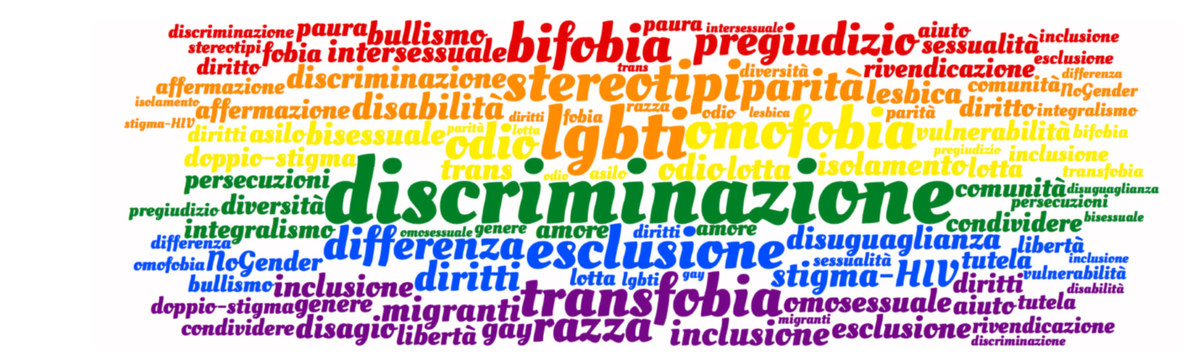
 LGBTI people are often, as such, the object of homophobia, biphobia, and transphobia, that is, discriminatory, stigmatizing, and violent attitudes, actions, and discourse. Sometimes LGBTI people are also subjected to multiple discrimination, as in the case of LGBTI migrants. Homophobia and transphobia can manifest themselves as overt violence or in the form of many small and large events These insidious and constant occurrences in the daily lives of LGBTI people, in families, at school, at work, on the streets, and in many other contexts. Arcigay fights to ensure that discrimination and violence motivated by homophobia and transphobia are treated as hate crimes. Furthermore, for some years now, organized groups, so-called "anti-gender" groups, have been active, spreading manipulative and at times paranoid propaganda to fuel fear and hostility towards any form of inclusion and openness in society and institutions towards LGBTI people and gender equality. They have a religious and ultra-conservative background, despite describing themselves as "non-denominational.". Homo-transphobia is therefore a vast phenomenon, also organised around the "anti-gender" movement“, and Arcigay fights against it on multiple levels.[:en]LGBTI people are often, as such, the target of homophobia, biphobia, and transphobia—that is, discriminatory, stigmatizing, and violent attitudes, actions, and discourse. Sometimes LGBTI people are also the target of multiple discrimination, as in the case of LGBTI migrants. Homo-transphobia can manifest itself as overt violence or in the form of many small and large incidents that occur in a subtle and constant way in the daily lives of LGBTI people, in the family, at school, at work, on the street, and in many other contexts. Arcigay fights to ensure that discrimination and violence motivated by homo-transphobia are treated as hate crimes. Furthermore, for some years now, organized groups, so-called "anti-gender" groups, have been active in spreading manipulative and at times paranoid propaganda to fuel fear and hostility towards any form of inclusion and openness in society and institutions towards LGBTI people and gender equality. They have a religious and ultraconservative background, despite describing themselves as "non-denominational." Homophobia and transphobia are therefore a widespread phenomenon, also organized around the "anti-gender" movement, and Arcigay fights against it on several levels.