
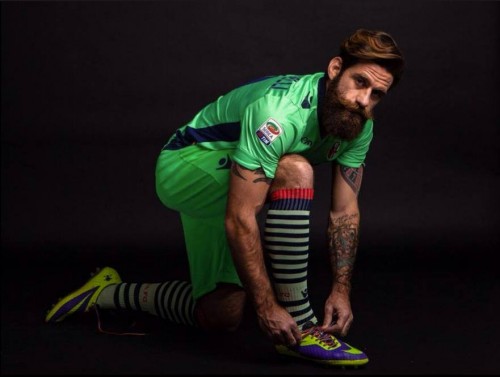
The first to wear them was Davide Moscardelli, Bologna's thick-bearded striker, who readily agreed to be one of the spokespeople for the first campaign against homophobia in sport. A pair of rainbow laces, to be worn on his boots during matches, reminds everyone that discrimination in sport is "offside." This is the essence of the initiative launched by Paddy Power and the national associations Arcigay and ArciLesbica, in collaboration with the Candido Cannavò Foundation for Sport, which has been taking over social media for a few days with a hashtag that is actually an exhortation: "Let's tie them up." Moscardelli is joined by Gianmarco Pozzecco, who, like a good "coach," convinced his Capo d'Orlando boys to get involved in an ad against homophobia: "I've never had the fortune of playing with an openly gay teammate," he said, "but I know full well that among my teammates there were some homosexuals and that it was impossible for them to say it openly, to come out publicly." "The fight against homophobia, lesbophobia, and transphobia," say Flavio Romani (president of Arcigay) and Paola Brandolini (president of ArciLesbica), "is not solely aimed at demanding criminal legislation that punishes acts of violence, so-called hate crimes. In these months of intense debate inside and outside the halls of Parliament over the extension of the Mancino law, Arcigay and ArciLesbica, together with the other associations and groups that make up the LGBT (lesbian, gay, bisexual, and trans) movement, have never stopped working on the social and cultural front, attempting to change contexts and address the origins of discrimination, hostility, and violence against gay, lesbian, and trans people. Schools, universities, workplaces, public administration, health and social services: these are all areas in which we have long and consistently attempted to bring about change, in the belief that addressing the issue of hate crimes means first and foremost changing the contexts, educating them in a plural vision of identities and orientations, breaking down the barriers that marginalize LGBT people by building environments for them that favor the full expression of their individuality, which includes not only love, desires, relationships, but also ideas, creativity, and talent.“ The rainbow lanyards were distributed to 4,000 male and 1,000 female soccer players, as well as basketball and volleyball athletes. They were also delivered to celebrities and Olympic athletes, always accompanied by the same request: let's kick homophobia to the curb. "The campaign," Romani and Brandolini continue, "asks athletes to spread a message and take direct action to change a context that has been repeatedly denounced as problematic in terms of discrimination, not only against gays, lesbians, and transgender people. We ask them, through the simple act of wearing rainbow laces on their shoes, to break down a barrier and contribute to the empowerment of LGBT people on the playing fields, in the stands of stadiums and arenas, and in the homes of many fans. Sport, after all, has always chosen its champions, models of a healthy lifestyle, of good ambitions, and of goals achieved through commitment, pride, and loyalty. Today, we ask these champions to earn a new medal, of all colors, that recognizes football for its contribution to defeating homotransphobia.".