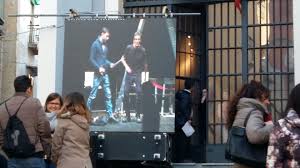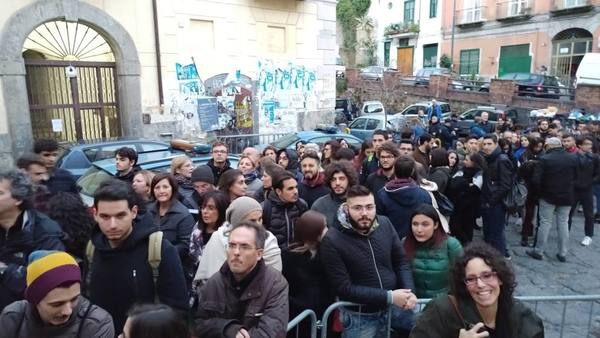
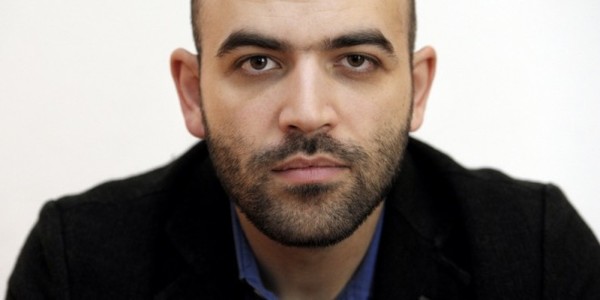
It's Saturday morning. But it's not a Saturday like any other. In fact, today is November 12th and in the Sanità district of Naples, it has arrived Roberto Saviano who is preparing to present, in national preview, his new novel, The Children's Paranza, published by Feltrinelli.
The event will take place in the afternoon, in the hall of New Sanità Theatre, directed by the playwright and director Mario Gelardi. And it's no coincidence, because Gelardi, Saviano's friend and associate, has transformed this space into a true outpost of rights, civic engagement, and legality.
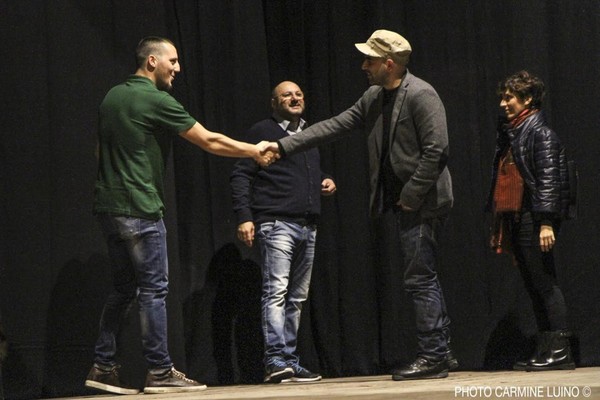
Since huge crowds are expected for the presentation, we take advantage of Gelardi's availability to meet Saviano a couple of hours before the event and ask him a few questions.
Roberto, you've always had a very clear and unequivocal position in support of the LGBT community. In the speech you sent to Arcigay at the last National Congress, held in Naples in 2015, you highlighted the backwardness of a country that denies rights to LGBT citizens. After the Cirinnà law on civil unions, what's the current situation?
In my opinion, there is still a lot to do. The civil unions law is a great achievement, but it's not everything. What amazes me is this kind of two-track approach: on one side, politicians, so cautious, so stuck, and so terrified of losing support—after all, this is why the so-called "stepchild adoption" was removed from the law—on the other, the judiciary, which appears enlightened and often intervenes to "fix" gaps in the law. As always, the path is contradictory in Italy: one step forward, one step back. The problem is knowledge; everything starts with the dissemination of knowledge, the only strategy for destroying prejudice.
Your latest novel, La Paranza dei Bambini, focuses heavily on the plight of young people. How can you combat prejudice and stigma among young people?
In this novel I tell exactly how these guys from the fishing village use a lot a sexist vocabulary to talk about their moods and what they are experiencing. What can we do with the younger ones? It's always a matter of knowledge; I don't think there's much else. And above all, we need to provide a lot of sex education. After all, even when I was in school, homophobia was part of the private syntax of the classroom. And I too, when I was very young, was crossed by homophobic feelings Because I lived in the Campania hinterland, which is even more closed and difficult. And then we need to tell kids that it's wrong to identify people with a single "characteristic," to reduce different individualities to a single subjective expression. And in fact, when I hear someone say "I have many Jewish friends..." or "I have many gay friends...", I perceive homophobic or anti-Semitic prejudice. Because those who express themselves this way reduce individualities to a single attribution that neither describes nor conveys the complexity of a woman or a man. We must stop reducing the complexity of others to a single characteristic or a single belonging.
How much homophobia is there in mafia circles?
Homophobia is very present in the criminal environment. And the level of homophobia varies from clan to clan. The Casalesi and the Mallardo are very homophobic, while those affiliated with the Giugliano and Misso clans are less so: each clan has its own interpretation of the homophobic stigma. Everything that involves freedom, sexual freedom, and awareness of one's own body undermines the mafia dynamics. In the 80s, you couldn't join Cosa Nostra if you were homosexual, if you had homosexual relatives. And if your parents were divorced. The moralistic rigor, apparent rigor of course, of these organizations is enormous because they fear anything that is an expression of freedom..
Do you remember cases where mafia crimes also had an element of homophobia?
In several cases homophobia has had to do with murders or mafia and camorra incidents. I remember a member in prison in the 1990s, in Santa Maria Capua Vetere, hanged because he had had a homosexual relationship with a Tunisian boy in his cell, and the clan, out of shame, eliminated him. Relatives of clan members are often beaten and threatened because they are homosexual. The presence of homosexual people tarnishes the image of the clan. Indeed, during a trial, a major Camorra boss tried to discredit the statements of another boss from the historic center of Naples by saying, "Mr. Judge, do you listen to this guy who has a gay son?" And the other, "accused" of being unreliable because he was the father of a homosexual, replied, "No, that's not true, he's not gay, he's just very sensitive.". There is even fear of pronouncing the word homosexual in the world of the Camorra and the Mafia.
Despite everything, do you think Naples is a welcoming and inclusive city for LGBT people?
In my opinion, yes. Naples has a tradition of hospitality And it's a seaside city where homosexuality has always enjoyed the dignity of citizenship. Paradoxically, in Naples the most closed-minded segment has always been the bourgeoisie, while the common people have always been naturally "porous" and therefore welcoming.
We leave Roberto Saviano to the questions of the other journalists who, in the meantime, have arrived at the theatre. In the cardboard boxes piled up in the foyer, hundreds of copies of the The Children's Paranzai. Around us, in addition to my colleagues from major Italian newspapers, I see so many young people. They are the young people who carry on the daily fight for a better world. They are all from the Rione Sanità neighborhood. And in the age of social media, they have chosen theater to transform their own future and that of those who believe in a more just society.
(Claudio Finelli, Arcigay Culture Director)