
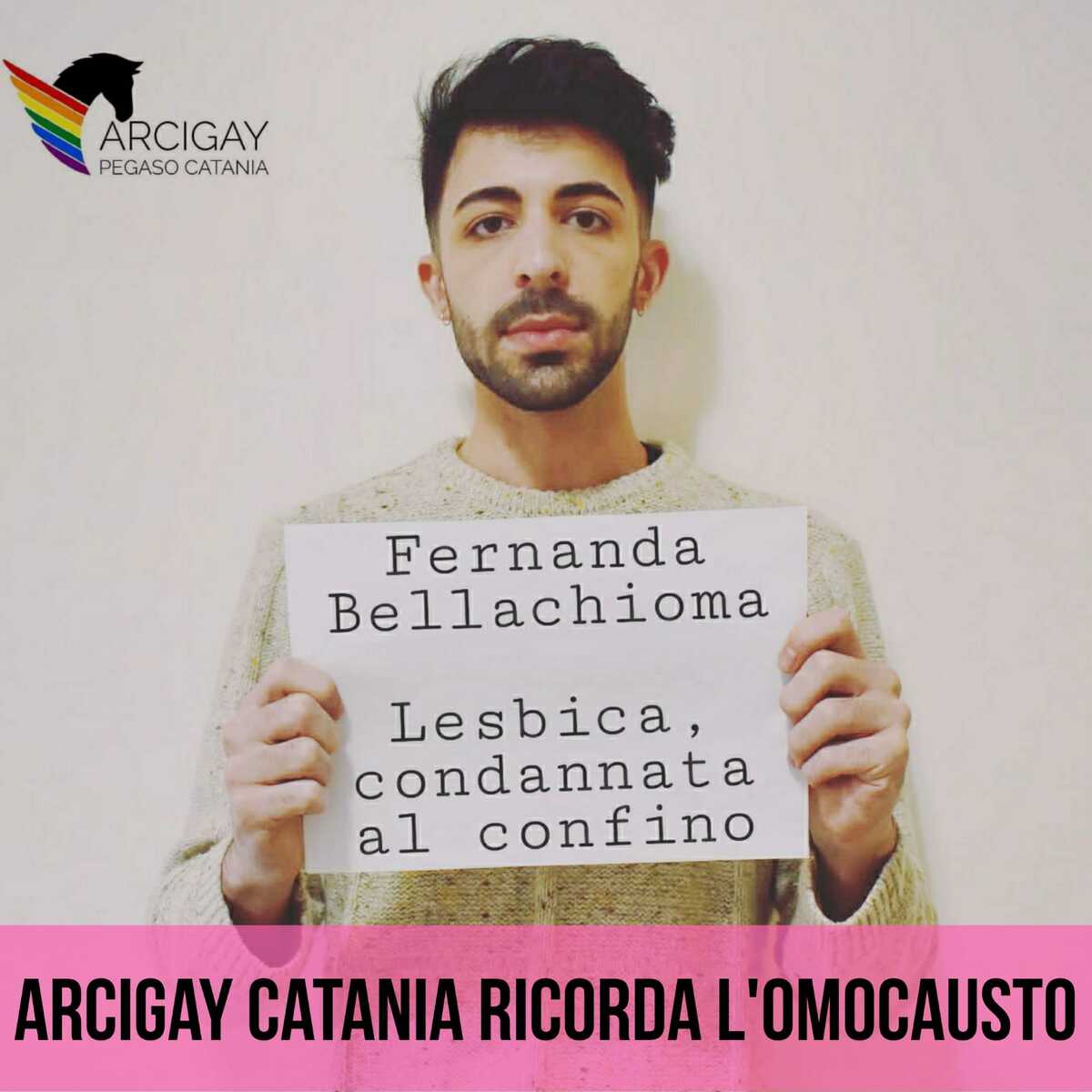
[:it]On Holocaust Remembrance Day 2021, Arcigay Catania remembers the victims of the Nazi holocaust and fascist confinement. The latter hit our city particularly hard.
We wanted to give a voice to the victims, imagining them recounting firsthand the events they experienced. The following text is therefore fictional, but all the facts narrated are true.
FERNANDA BELLACHIOMA
My name is Fernanda Bellachioma. I was born in Perugia in 1889 to a local middle-class family. I didn't have a happy childhood; my father was a violent man who regularly beat me and, until she died of fulminant pneumonia, my poor mother. But one day, thanks to a teacher who boarded with us and who proved to be my most faithful friend, Enrichetta, I managed to escape him. I started a new life, constantly worried that he would find me, because my father couldn't easily accept the fact that I had escaped his control. Luckily, I spoke English perfectly, so I began giving lessons to earn a decent living. I was welcomed by many families in this city and sought after.
That's how I met Violet Righetti-Collins in 1925. She was of English origin, but lived in Perugia with her husband, a well-known doctor. When he was away on business, I would go and keep her company, and we slept in the same bed. Our relationship, in the eyes of everyone, was that of two friends. Her marriage to Professor Righetti provided Violet with the necessary guarantee of heterosexuality, and thus we were able to manage our romantic relationship better.
An unforgettable summer was 1927, when I spent three months at the seaside in Viserba with Violet. Upon returning from that vacation, she packed up her things from the house in Perugia and filed a lawsuit to separate from her husband. I followed her. Dr. Righetti filed a lawsuit against his wife for abandonment of the marital home. The case caused quite a stir, reaching as far as Rome.
On August 22, 1928, a telegram from the head of the Fascist police, Arturo Bocchini, ordered: "It is ordered that Fernanda Bellachioma […] be assigned to confinement and sent to Castrovillari stop […]." It was August 24 when I was arrested, I was in the seaside house in Viserba with Violet, and I was taken to the prison in Rimini.
A woman like me, who had an income and no husband to manage it, a lesbian, posed a danger to the regime and the state. The others, if they married (and few did not, given the opportunity, because women received some consideration only as wives and mothers), passed directly from the father's authority to that of the husband, and the husbands also managed their assets, for the few who had anything.
My arrest had been arbitrary, however, because homosexuality was not a crime in Italy. Making it illegal would have implied our existence, something Mussolini was unwilling to do. In Italy, he said, homosexuals did not exist.
On September 3, an appeal was filed against my trial, which argued that even if the accusation were true, it was not provided by law as a reason for confinement, and questioned whether such a "deviance" could be subversive of the state's laws (subversion was one of the possible reasons for a sentence of confinement).
A series of cross-communications followed between Perugia, Forlì, Rimini, and Cosenza, the province where I was supposed to be confined. The Calabrian minister Michele Bianchi, a Quadrumvir and first secretary of the National Fascist Party in 1921, evidently shocked by the possible presence of a lesbian in his native land, even managed to have the place of confinement moved to Agropoli, in the province of Salerno.
The Confinement Office also received an anonymous typescript full of petty lesbophobic infamy, signed in the name of an unspecified “citizen of Perugia,” in which not even my lawyer and his family were spared: the daughter was described as a “furious lesbian.”.
However, a supplementary investigation was ordered and at the same time an expert report by the provincial doctor certified my unfitness to undertake the journey due to a series of "female syndromes" worthy of the best positivist medical codification: from nervous exhaustion to a probable uterine polyp.
On September 5, a telegram arrived at the prefect of Forlì informing him that Mussolini himself had ordered the revocation of the confinement, not because he was magnanimous, but because in that phase of consolidation of the regime it was better to silence than to punish.
My case constitutes a unique, both because it was the first sentence of confinement of a woman because she was a lesbian, and because the measure was revoked.
So in 1929 I went to live in Rome with Violet.
Author: Fabio Cardile
Editing: Vera Navarria
Graphic design: Daniele Russo
Sources:
- “Outside the Norm” Lesbian Stories in Italy in the First Half of the Twentieth Century, edited by Nerina Miletti and Luisa Passerini, Rosenberg&Sellier, 2007.
- “Lesbian R/esistences in Nazi-Fascist Europe,” edited by Paola Guazzo, Ines Rieder, Vincenza Scuderi, Ombre corte, 2010.
- “A young lady in exile” article published by “Il Messaggero” on 26/08/1928.
- “Viserba, Villa Bavassano: scandal in the sun” article written by Lussi Pagammo in the online newspaper “Rimini 2.0” on February 15, 2018.

[:]