

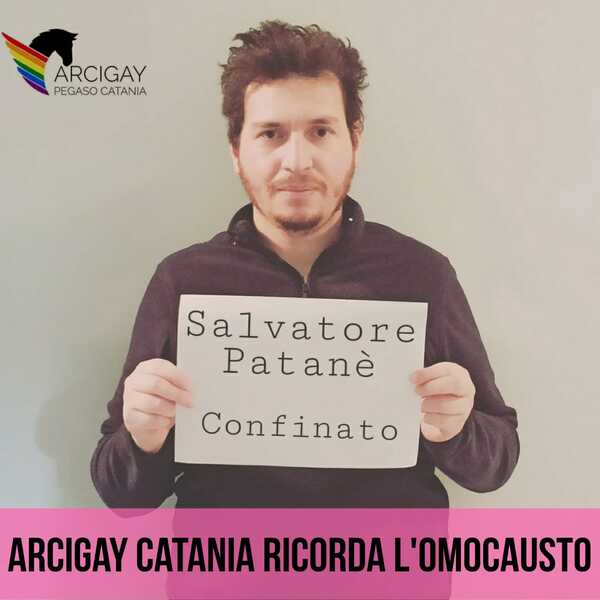
[:it]On Holocaust Remembrance Day 2021, Arcigay Catania remembers the victims of the Nazi holocaust and fascist confinement. The latter hit our city particularly hard.
We have wanted giving voice to the victims, imagining that they were recounting firsthand the events in which they were involved.* The following text is therefore fictional, but all the facts narrated are true.
SALVATORE PATANÈ
My name is Salvatore Patanè. I was born in Catania in 1915. I was a tailor, I loved fabrics and I dressed elegantly and sophisticatedly. My nickname was "Chinchilla" because, like this friendly rodent, I never sat still. I loved traveling. I also visited Palermo and Milan, where I had my adventures... In Catania, I preferred to attend dinners and private parties organized by my friends. This allowed me to meet men and maintain a certain degree of discretion compared to those who secluded themselves with their lovers in the surrounding area.’'arvulu rossu (that is, the large tree, a centuries-old plane tree that you can still see today, in front of the Archi della Marina).
We all knew each other, more or less, because we went to the same dance halls.
In Piazza Sant'Antonio was the most famous men-only ballroom. Admission was free. Each dance cost twenty cents, so for little money you could have a whole evening's entertainment and make interesting encounters. There, in fact, you could meet the male looking for an adventure with some jarrusu (or arrusu).
The “males” (male In the Catanian culture of the 1930s, it was men who took the active role during sexual intercourse. Men were free to have relationships with both women and other men. The latter were instead called jarrusi (Catanese term to indicate passive homosexuals) and their sexual role was similar to that of women.
On January 14, 1939, I was unexpectedly and inexplicably arrested. A date I will never forget because it changed my life forever. I wasn't alone. Within a few days, there were about twenty of us. The interrogations began on January 18.
The next day, the cell bars opened again. I thought they were freeing us, but instead they took us to Garibaldi Hospital and handed us over, in turns, to our torturer. The doctor had us strip naked and, after a careful examination of our sphincters, made the diagnosis: "passive pederasty." At the end of the visit, we were transferred to the prison in Piazza Lanza, appropriately separated from the other inmates.
By order of February 2, 1939, I was sentenced to serve 5 years of confinement.
For three months I was confined to Ustica, where I spent five days in jail for working as a barber without a license or permit. In May I was transferred to San Domino, a nearly deserted island in the Tremiti Islands. We homosexuals were divided into two large rooms that were locked at sunset and reopened the next morning. We had to abide by numerous rules and restrictions. Sanitary conditions were poor, as was the quality of the food. There was little work, and prices were high. The daily allowance of four lire, later increased to five, wasn't even enough to cover essential expenses, let alone send money home. I tried in vain to request a change of island. On June 7, 1940, I was released. My remaining sentence was commuted to two years of reprimands, as Police Chief Bocchini had arranged with Mussolini's approval. The gesture was not dictated by compassion; the island, in fact, had to be liberated as soon as possible to accommodate more dangerous political prisoners.
Not even a month after my return to Catania, the city was bombed, adding further dismay to my already broken soul. I had no brand imprinted on my skin like those deported to concentration camps, but I still had to deal with the social stigma. The warning made the situation worse. I wasn't free to go out whenever I wanted, nor meet with whomever I wanted, because I had to report every move to the police. I had set times for going out and coming home. I couldn't regularly frequent public places and was absolutely forbidden to attend meetings. All of this only fueled the discredit that public opinion already held against me.
I was tired. People continued to gossip. So I did the only thing I could do in those years to silence the rumors. I got married. That marriage was beneficial for both me and my wife, who was a single mother. She, her son, and I went to live in the old San Berillo neighborhood. Meanwhile, in addition to working as a tailor, I worked as a clerk in a well-known shoe store. I had no children and never spoke to anyone about my past. I've been dead for over 40 years and took my secret to the grave, but today the time has come for it to come to light.
During the Fascist era, confinement was one of the primary tools used against those deemed by the police to be "pederasts." Specifically, in Italy in 1939, 66 people were sent into confinement for homosexuality, 45 of whom were from Catania. Mussolini personally approved the confinement of the first 20 passive pederasts from Catania (which included Salvatore Patanè). Homosexuals were considered socially dangerous because they caused scandal, disrupting public morality and undermining the prestige and integrity of the race. Repression targeted passive homosexuals in particular because they undermined the fascist canon of virility, which considered passivity a feminine characteristic. Police commissioner Alfonso Molina worked almost obsessively to eradicate pederasts from the Catania area. The files of these internees, unlike those of other Italian provinces, consisted of detailed biographical reconstructions, psychological portraits, interrogations, medical reports, anonymous complaints, pleas and appeals, letters and appeals, etc. In 1940, Molina included the men who accompanied the Jarrusi in his crusade, but he had little success because they were wealthy individuals with resources that hindered the police's work of gathering evidence and identifying them. At the end of the war, Police Commissioner Molina was acquitted by the High Commission for Sanctions against Fascism and even ended his career with two medals for civil valor.
Persecuted homosexuals and their families, however, were ashamed to make the incident public, so the memory was hidden for decades and is only recently resurfacing.
Author: Fabio Cardile
Editing: Vera Navarria
Graphic design: Daniele Russo
Sources:
– “The City and the Island” Homosexuals in Confinement in Fascist Italy, edited by Gianfranco Goretti and Tommaso Giartosio, Donzelli, 2006.
– “The Enemy of the New Man” Homosexuality in the Fascist Totalitarian Experiment, edited by Lorenzo Benadusi, Feltrinelli, 2005.
– “The People in Confinement” Fascist Persecution in Sicily, edited by Salvatore Carbone and Laura Grimaldi, Central State Archives, 1989.
– Research on registry records.
– Interviews with some relatives of Salvatore Patanè.
[:]