

[:it]
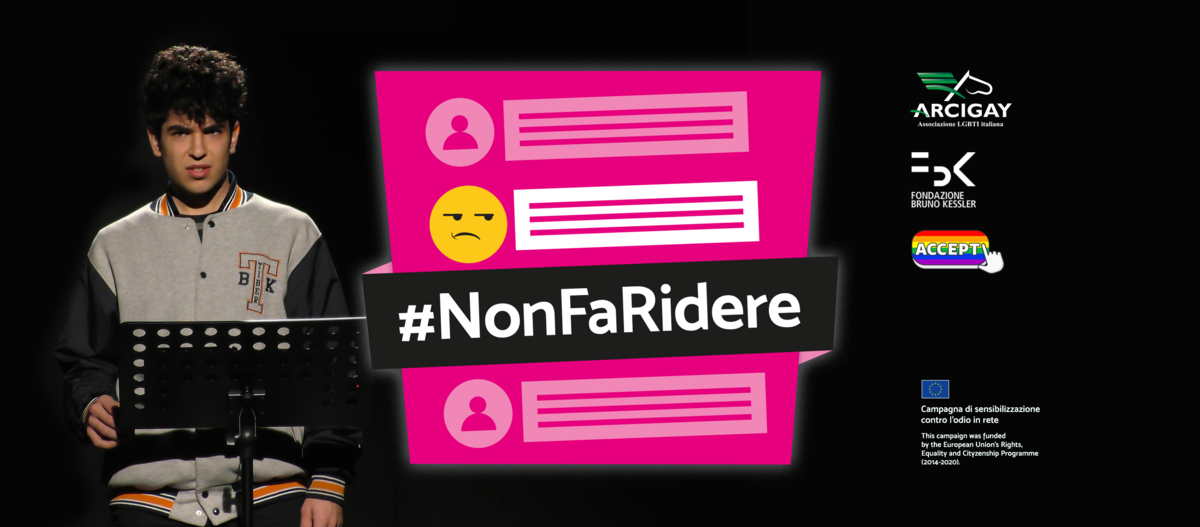
“"NOT LAUGHING": ARCIGAY'S VIDEO TO COUNTER HATE SPEECH IS NOW ONLINE
The initiative is part of the European Accept project, developed in collaboration with the Bruno Kessler Foundation. More than 500,000 online contents were monitored.
Bologna, March 21, 2019 – It's titled "It's Not Funny"“ the social campaign Arcigay is launching a campaign to combat online hate speech, particularly that which masks homophobia, lesbophobia, transphobia, and biphobia with irony, making them socially acceptable and even viral on the web. The initiative is part of of the European Accept project Created by Arcigay together with the Bruno Kessler Foundation of Trento, the project monitored nearly 530,000 pieces of content, including tweets, news items, and Facebook posts, using a platform specifically designed by the foundation's technicians. For one year (from March 2018 to February 2019), a panel of evaluators (diverse in terms of geographic origin, gender, sexual orientation, age, and education level, but united by their declared adherence to liberal, progressive, and democratic socio-political positions) classified the tweets (positive if they demonstrated an open and inclusive stance toward LGBTI people, negative if they were exclusionary, discriminatory and offensive, and dubious if the message was ambiguous or difficult to decipher). The analysis sifted through the material and resulted in a sample of 5,189 tweets, which allowed us to draw some initial conclusions. First, hateful messages can be divided into three clusters: entertainment, public debate and current affairs, and rights and ethical issues. The most recurring words in negative messages are: faggot, propaganda, order, and nature. The most recurring words in positive messages are: citizens, group, associations, and social. Questionable messages include: privilege, joke, prank, and opinion. Furthermore, the most polarizing tweets—those with which the evaluators disagreed the most—disguise hateful words with sarcastic intent. One in ten people expresses discriminatory positions when discussing LGBTI topics, while four in ten express ambiguous positions, at least half of which are attributable to language that is ironic in form and offensive in intent.
Based on these considerations, with the help of the’Pavlov Communications Agency, we chose to produce a counter-narrative focused on the fine line between joke and insult, between free opinion and discriminatory language, highlighting the dangers and contradictions that exist on that boundary. Hatred thrives wherever the message is conveyed that one social group is more deserving than another, due to its supposedly superior characteristics. The video "#nonfaridere" seeks to bring out the rational side, exaggerating the dynamics of what is accepted as a "joke" but is instead considered gratuitous insult. The video itself, shared on social networks, will be monitored to quantitatively and qualitatively measure web users' reactions to the counter-narrative. Finally, on April 15, at the European Commission Representation in Palazzo Campanari in Rome, the Accept project will be discussed in its methodology and substance, including data, the video, and all the resulting analyses.
[:]