Arcigay has long been concerned with the health of LGBTI people, defining priorities from time to time based on available resources. LGBTI health is a broad field that encompasses a variety of issues, from sexual health to psychological well-being, from substance use/abuse to aging. The association's goal is to help LGBTI people take full control of their health and well-being, despite the social inequalities that still characterize the lives of LGBTI people.. Indeed, it has been demonstrated that social inequalities in general have a significant impact on health, and those related to sexual orientation and gender identity are associated with various potential health problems. LGBTI people are in fact at greater risk of experiencing health problems than heterosexual people [Meyer et al., 2008; Wolitski et al., 2008; Meyer et al., 2007; Clements et al., 2001; Solarz, 1999].
The minority stress
One of the key elements of the impact of inequality on LGBTI people is the so-called “minority stress”, that is, that condition of strong chronic stress due to the very fact of belonging to a stigmatized and discriminated minority, in this case sexual. The mechanism is very simple: the stigmatization situation doesn't directly cause health problems, but it keeps the stigmatized person in a state of chronic stress that they, depending on their resources, can manage in more or less "positive" or "negative" ways, and this management can have different outcomes on their health. Obviously, therefore, not all LGBTI people experience health problems related to minority stress, but the risk of this occurring is much higher than for non-LGBTI people by virtue of that very specific condition.
There are two macro-factors of minority stress: the "distal" ones, which concern the "external" sphere of the person and which materialize in actual events of stigmatization, discrimination, violence and prejudice suffered, and the "proximal" ones, which concern the internal sphere of the person with specific phenomena such as internalized homophobia (self-hatred for one's homosexuality), the constant expectation of rejection and the effort to hide oneself (the more or less continuous attempt to "pass as" heterosexual by lying, dissimulating, omitting, pretending, etc., to avoid being stigmatized).
The impact of the minority stress on health
LGBTI people are more likely to have experienced health and psychological well-being difficulties, such as substance abuse, attempted suicide, depression, and anxiety, during their lifetime. Studies have shown, for example, that gay, lesbian, and bisexual people are 2.5 times more likely to have experienced difficulties with psychological well-being in their lives. In some cases, a relationship has been proven between "distal" factors (experienced discrimination), such as peer discrimination and hostility, and various psychological difficulties, suicide risk, anxiety, or substance abuse. But the "proximal" factors (those affecting the internal sphere) are the most subtle: it is now clear that internalized homophobia is linked to self-harm, eating disorders, and increased sexual risk, as well as to a general state of psychological stress, which in turn has negative long-term health outcomes.
Despite the growing body of scientific evidence clarifying the need for specific attention to LGBTI people, Italian health authorities rarely address this issue, even when the disproportionate impact on the LGBTI community is clear and well-known, such as in the fight against HIV (see below).
Arcigay's goal is therefore to bring to the attention of health authorities the need for a more focused approach to the health needs of LGBTI people and the elimination of barriers between them and services. Indeed, a 2005 Arcigay survey of 6,744 LGBTI people, "Modi di," showed that just over 30% of them feared negative reactions from their doctor if they came out, and that, in fact, 8% of lesbian women and 6% of gay men had not disclosed their homosexuality to their doctor.
Sexual health
In recent years, as sex has begun to be thought of as more than a mere reproductive means (for having children), sexual health (i.e., regarding sexuality) has also begun to be discussed as a new concept, previously "implicit" in the concept of reproductive health (i.e., regarding the reproduction of children). According to a definition by the World Health Organization (WHO), we are all sexual beings, and remain so throughout our lives, regardless of whether we have children or not: sexuality is a central aspect of being human throughout life, and includes sex, gender identities and roles, sexual orientation, eroticism, pleasure, intimacy, and reproduction. Sexuality is experienced and expressed in thoughts, fantasies, desires, beliefs, attitudes, values, behaviors, practices, roles, and relationships. While sexuality can include all of these dimensions, not all of them are always experienced and expressed by people.
According to the WHO itself, Therefore, "“Sexual health is a state of physical, mental, and social well-being related to sexuality. It requires a positive approach to sexuality and sexual relationships, as well as the ability to have safe and pleasurable sexual experiences, free from physical coercion, discrimination, or violence..”"Not only the integrity of the body as safety from disease, but also the need to know one's own body, its sexual response and its pleasures, within a framework of safety, responsibility and respect for others, and of consensual relationships that provide mutual pleasure.
Cultural limitations and delays, including religious ones, regarding the body and sexuality continue to undermine the concept of "sexual health" in Italy. This translates into a dramatic inability on the part of health authorities to "view" health issues related to this area with a coherent, specific, and open perspective. It is no coincidence that, with rare exceptions, Italy lacks "sex clinics" where the risks associated with sexual activity are addressed together, focusing on prevention and a relationship with the individual and their sexual needs. This lack is a problem that Arcigay seeks to address by providing LGBTI people with all the information they need to best equip them to choose whether and how to protect and improve their sexual health within a framework of the right to pleasure and respect for themselves and others.
HIV is still a priority
Since 2008, the association has been particularly committed to a strategy to fight HIV and reduce the stigma suffered by people living with HIV, and since 2012 it has equipped itself with a guiding document Voted by the then National Council. This area of action has become a priority for the association for two main reasons:
- Gay or bisexual men and MtoF transgender people continue to be particularly affected by the epidemic worldwide, which has further grown in this subgroup in recent years and which nevertheless characterizes it by a high prevalence (the percentage of people living with HIV in a given population), in Italy estimated at around 10% among gay and bisexual men;
- HIV is not only an infection that can have serious consequences if not treated with today's highly effective therapies (which effectively make it chronic and manageable and even non-infectious for others), but above all it is a source of hateful stigmatization that adds to the stigma already attached to one's (homo or trans)sexuality that also attaches to HIV: the fact that there are many people living with HIV among gay or bisexual men and trans people, and with them their potential partners, family members and friends, places the community and the association itself in a position of additional responsibility for the well-being of all.
In essence, ours is, whether we like it or not, an "HIV-involved" community, but it has a poor perception of it also due to the stigma and taboos associated with HIV. There are several reasons why gay and bisexual men are more exposed to the risk of HIV and, for the most part, they are not linked to a different, more or less "responsible" way of experiencing sex: the high prevalence, anal sex itself, the structure of contact networks, homophobia (Click here for more information). In short, therefore, a gay or bisexual man must make a much greater effort at prevention and risk reduction than a heterosexual person, because the starting conditions are already disproportionately "higher risk".
The knowledge and tools we have today about HIV would allow us to eliminate both the epidemic and the stigma associated with HIV. In fact, today, a person living with HIV who is undergoing treatment and has the virus in their blood monitored to undetectable levels has a virtually zero risk of transmitting the infection.. It is virtually non-infectious. In fact, it is believed that the epidemic is fueled primarily by those who have HIV but are unaware of it and therefore do not take treatment, thus unknowingly transmitting the virus. To a much lesser extent, however, are those who know they have it but, for various reasons, do not take treatment or take it incorrectly, rendering it ineffective. This aspect has a crucial impact, both because it offers an important tool for halting the epidemic and because it highlights the violence and futility of stigma against people living with HIV, even in the sexual sphere.
Arcigay's work on HIV
The document voted in 2012 by the association (also confirmed in the last congress), gave the association the mandate to work primarily on HIV with a combined prevention approach that takes into account and brings together all the aspects and tools useful for stopping the epidemic and improving people's well-being, both those at risk of HIV exposure and those living with HIV: condoms and lubricants, reducing HIV stigma, TasP (treatment as prevention), PrEP, focusing on sexually transmitted infections that contribute to the epidemic, reducing homophobia, and increasing access to HIV testing. The association's ultimate goal is for our community, especially gay and bisexual men, to:
- know and frequently check their HIV status;
- can talk calmly and openly about HIV, how it is managed and how it is avoided, without irrational and counterproductive fears;
- have access to all available prevention tools and to all useful information to minimize and manage the risk;
- If they live with HIV, may they live well like everyone else, including the perception of being able to “come out” without fear of being rejected just because of their HIV status.
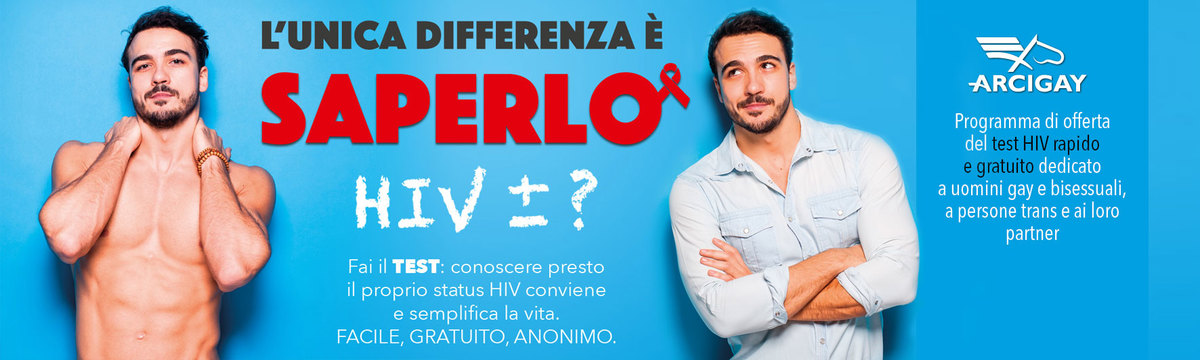
In this context precisely access to HIV testing has become a strategic element and key to Arcigay's prevention efforts, and the association has committed resources to several projects, along with a greater effort to combat the stigma associated with HIV. Arcigay's goal is to achieve ever greater integration between public health services and community-based services managed directly by the associations: for this reason, since 2015, Arcigay has opened rapid HIV testing points in 10 cities, offered primarily to gay and bisexual men and trans people.. The community-based approach is based on the principle that members of the LGBTI community are more familiar with the language, ways and needs of the community than health authorities, can speak more openly with a sex-positive approach, can more easily reach the people who need to be reached by prevention work and can therefore manage the same services with better results.
At the national level, Arcigay is present in Sections L (Fight against AIDS) and M (Volunteering for the Fight against AIDS) of the Ministerial Technical Health Committee, where it carries out ongoing advocacy work to the ministry and public institutions so that they take more seriously, through concrete actions, the need for greater and prioritized efforts to support those most in need of prevention. Furthermore, Arcigay is a member of the Scientific Program Committee (SPC) and the Community Subcommittee (CsC) of ICAAR – Italian Conference on AIDS and Antiviral Research, the national AIDS conference. At the European level, it is a member of AIDS Action Europe.
Programs and projects:
ProTEST: A program to promote and offer rapid, free, and anonymous HIV testing in non-hospital settings (association offices, LGBTI events, saunas, nightclubs, etc.), primarily aimed at gay and bisexual men and transgender people. The program was supported in 2015-2016 by the Union of Methodist and Waldensian Churches with 8×1000 funds and an unconditional contribution from ViiV.
References:
Mayer KH, Bradford JB, Makadon HJ, et al. Sexual and gender minority health: What we know and what needs to be done. American Journal of Public Health. 2008:98; 989-995.
Wolitski, RJ, Stall, R Valdiserri, RO. Eds. Unequal Opportunity: Health Disparities Affecting Gay and Bisexual Men in the United States. New York: Oxford University Press, 2008.
Clements NK, Marx R, Guzman R, Katz M. HIV prevalence, risk behaviors, health care use, and mental health status of transgender persons: implications for public health interventions. American Journal of Public Health. 2001;91:915-921.
Meyer IL, Northridge ME. Eds. The Health of Sexual Minorities: Public Health Perspectives on Lesbian, Gay, Bisexual and Transgender Populations. New York: Springer. 2007.
Solarz, A.L. Ed. Lesbian Health: Current Assessment and Directions for the Future. Washington, DC: National Academy Press; 1999.


 Arcigay has been dealing with this for some time now LGBTI health: it is a very broad field of work that touches on several topics, from sexual health to the fight against HIV and other STIs, from psychological well-being to substance use/abuse, from suicide risk to the issue of aging. The association's goal is Helping LGBTI people take full control of their health and well-being, despite the social inequalities that still characterize the lives of LGBTI people and which also impact their health. Due to social inequalities, in fact, LGBTI people are at greater risk of facing health-related issues and challenges compared to heterosexual people. With regard to the specific issue of sexual health and the fight against HIV, Arcigay gives it priority importance and works to ensure that prevention is respectful of the right to a fulfilling sexuality and include eliminating stigma related to HIV which still weighs on people living with HIV.