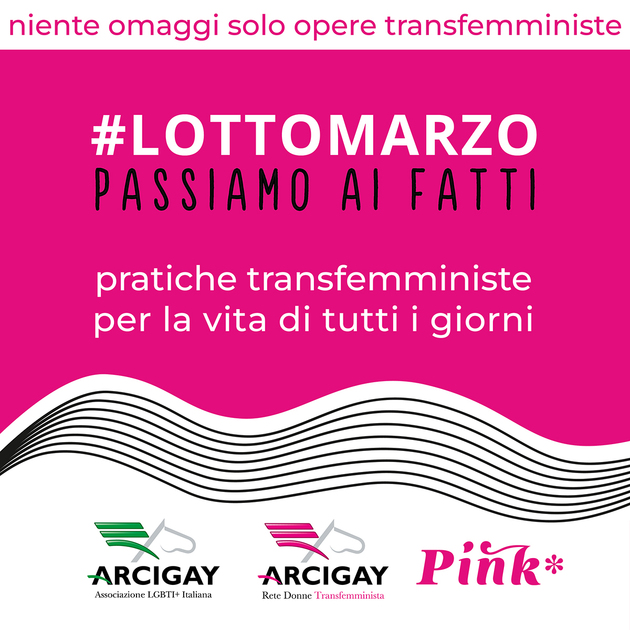
#LOTTOMARZO, let's get down to business
Transfeminist practices for everyday life
#NothingDoniButTransfeministWorks
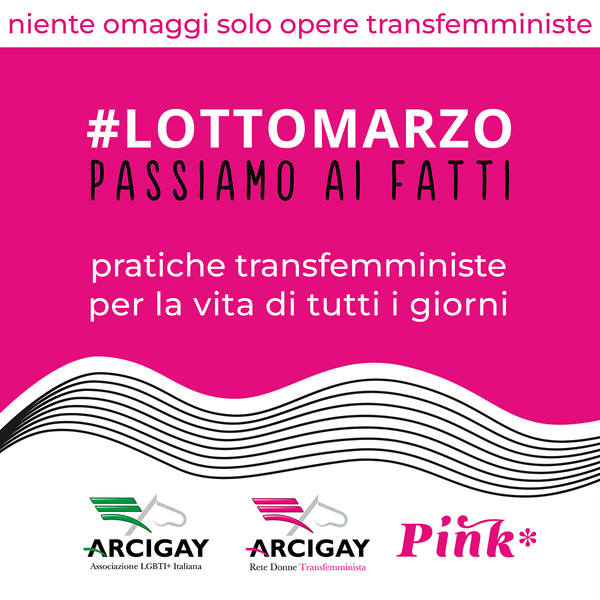
#LOTTOMARZO, let's get down to business
Transfeminist practices for everyday life
#NothingDoniButTransfeministWorks
The campaign conceived and created by @retedonnetransfemminista @Pink.ilgioco on the occasion of International Women's Day

You decide about your body
In Italy, voluntary termination of pregnancy (IVG) is regulated by Law 194 of 1978. However, we know that access to this service is not easy due to the extremely high percentage of conscientious objectors in gynecology departments. According to a 2019 Ministry of Health report, this percentage hovers around 671 TP3T nationwide, with very high peaks in some regions, such as Molise and Sicily. Although Law 194 prohibits objection by structure, there are at least 15 hospitals in Italy where 1001 TP3T of gynecologists are conscientious objectors, making voluntary termination of pregnancy virtually impossible. Medically assisted procreation is regulated by Law 40 of 2004. Since 2014, the Constitutional Court has repealed the ban on heterologous fertilization in our country (i.e., fertilization in which one or both gametes come from a donor external to the couple), and therefore the techniques that can be used today are both homologous and heterologous. However, the fact remains that these techniques are not accessible to singles or same-sex couples. Surrogacy (GPA), on the other hand, consists of carrying a pregnancy for other people, who may be single, or couples of the same sex/gender or of a different sex/gender. In Italy, GPA is considered a crime under Law 40 of 2004, but the ban is limited to Italy, which is why those who can afford it travel abroad to have access to parenthood. Our bodies belong to us, and we want to be free to self-determine ourselves, according to our will. This is why we want free access to voluntary termination of pregnancy, medically assisted procreation, and surrogacy.
#prochoice #ivg #gpa #pma
@retedonnetransfemminista @Pink.ilgioco

All bodies are valid
We live constantly under the gaze of the patriarchy, which judges, weighs, and evaluates our bodies, and based on its judgment, attributes value to us as women and as human beings. The gaze of the patriarchy is, unfortunately, a general social gaze that both men and women apply in everyday life and which has imposed very rigid norms and standards of beauty, based on thin, young, able-bodied bodies—bodies that can satisfy the male gaze. Discrimination is multiple and interconnected, and affects people with non-normatic bodies, those who do not fit into pre-established canons: particularly fat, disabled, Black, trans*, and older bodies. We, however, demand the freedom to escape this gaze, to deconstruct it, and to reveal it for what it is—that is, oppression and discrimination—against which we must fight together. For this reason, today, as every day, we forcefully reiterate that all bodies are fabulously different from one another and that all are valid.
#noableism #noageism #nograssophobia
@retedonnetransfemminista @Pink.ilgioco
 |
 |
 |
Use gendered language
Doctor, lawyer, surgeon, architect, magistrate. Do they sound bad to you? They don't sound worse than many other existing words, which no one has ever been scandalized by. Languages don't evolve based on the pleasantness of the sound, but on the principle of utility. Professional feminines serve to describe roles that were previously not intended for women, so there was no need for the feminine term to exist. We think they sound bad only because we're not used to using them and because we live in a patriarchal society that has taught us that everything conjugated in the feminine is less valuable, and therefore we perceive masculine terms as more prestigious. However, continuing to prefer masculine terms contributes to women being perceived as exceptions in those specific roles, as if they occupied them illegitimately and transiently, so much so that it's not even worth conjugating the term in the correct gender. Naming things means making them exist: words shape our thoughts and influence how we perceive the world and reality. Using the feminine to indicate professions and jobs traditionally reserved for men means, as Vera Gheno writes in Femminili singolari, "normalizing the presence of women in contexts where they were previously absent." It's therefore time to say enough and start using gendered language correctly.
1TP5Who’s afraid of the feminine?
@retedonnetransfemminista @Pink.ilgioco
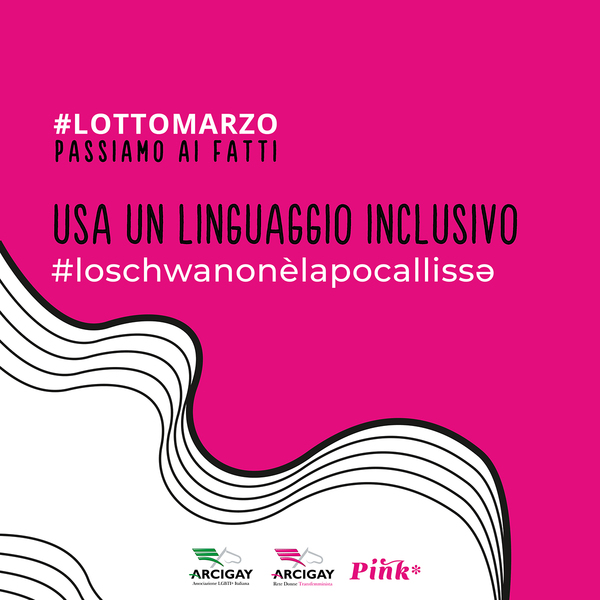
Use inclusive language
Italian grammar has a strictly binary structure, having only two genders: masculine and feminine. Furthermore, for the plural of mixed groups, in Italian, the overextended masculine is always used, creating amusing paradoxes when, for example, the masculine is used to indicate a group composed of many women and few men. However, people don't identify with just two genders, masculine and feminine, because non-binary, genderfluid, or agender people also exist. For this reason, in recent years, certain signs have been introduced, such as the schwa and the asterisk, which are used to address mixed groups, non-binary people, or people whose gender is unknown. The schwa (like other signs used for the same purpose) is not intended to subvert the language. No one thinks of overturning the morphosyntactic rules of Italian or rewriting literary texts using the schwa, because it would be impossible and even the mere thought of doing so is ridiculous. The schwa serves to represent all subjectivities through language, to make language a more inclusive and welcoming place for everyone.
#loschwanonelapocallissə
@retedonnetransfemminista @Pink.ilgioco
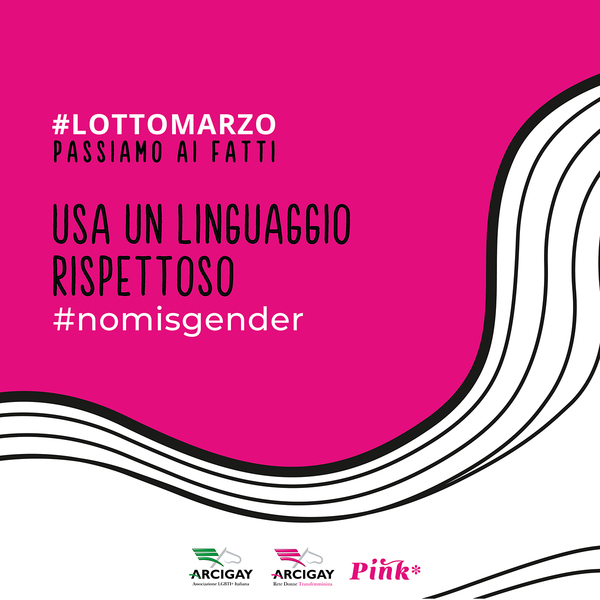
Use respectful language
Will it be a boy or a girl? How many times have you asked yourself this question when faced with a person whose gender seemed uncertain? This way of seeing other people is misleading because it ignores the fact that a person's gender could differ not only from their appearance, but also from their anatomical sex (besides the fact that genders aren't necessarily two). Human identity is complex and multifaceted; ignoring this and believing that everyone aligns with a single model undermines its validity, can hurt people, and hides diversity (which should be a source of enrichment, not fear). A good transfeminist practice is to avoid misgendering, that is, violating a person's sense of identity by assigning them a gender that doesn't belong to them, using the wrong pronouns. It's not just a question of correct language but of respect, which is why it's essential to ask people the pronouns they use to refer to themselves, without taking them for granted based on their appearance. It may be tiring at first, and you're sure to make mistakes, but it's definitely a practice that will make you and the world a better place.
#nomisgender
@retedonnetransfemminista @Pink.ilgioco

If there are no women, ask yourself why.
As the numbers show, the vast majority of top management positions are held by white, straight, cisgender men. This happens not because women or people belonging to other discriminated groups are less capable (the data tells us quite the opposite), but because patriarchal society assigns men a position of privilege and greater prestige, while everything involving women, or other marginalized individuals, is considered of lesser value. This is why there are still so few women in leadership positions today, and why it's still difficult to break through the so-called glass ceiling. If a person, in addition to being a woman, is also lesbian, non-white, or trans*, it will be even more difficult, since the discriminations intersect. Therefore, it's important to count the female presence, as Michela Murgia began doing in 2018, highlighting a widespread system of erasing an entire gender from the front pages of Italian newspapers, where the bylines were mostly male. Few, if any, are women university rectors, hospital department heads, conference speakers, and newspaper editors. Counting women highlights the numerical gap between women and men in fields where we would expect an equal distribution. Because, as Michela Murgia writes in Stai zitta, "until women can be there to count, it is essential that they continue to count in order to be there.".
#are not just numbers
@retedonnetransfemminista @Pink.ilgioco

Discrimination has many faces
An intersectional approach is one that begins with an awareness of the multifaceted nature of oppression. Just as an intersection in geometry is the point where multiple lines meet, discrimination is the result of multiple intersecting axes of oppression. For example, in a society that privileges white people, a non-white person will start from a disadvantaged position and will be more likely to be marginalized and discriminated against. If this person also belongs to the LGBTQIA+ community, they will be at risk of being the victim not only of racist violence and discrimination, but also of homo-lesbian-bi-trans-aphobic discrimination. If the person in question is socialized as a woman, sexism will be added to the other forms of discrimination, and so on. This is why some people are more likely than others to be targeted by different types of violence and discrimination. This means that to live in a world free of hate, it's not enough to fight just one form of discrimination (for example, racism), but we must fight them all (homophobia, lesbianism, biphobia, transphobia, sexism, ableism, fatphobia, classism, and ageism). "There is no such thing as a one-size-fits-all fight, because we don't live one-size-fits-all lives," wrote Audre Lorde. Precisely because discrimination has many faces, they must all be fought, and the fights must be intersectional.
#intersectionality
@retedonnetransfemminista @Pink.ilgioco
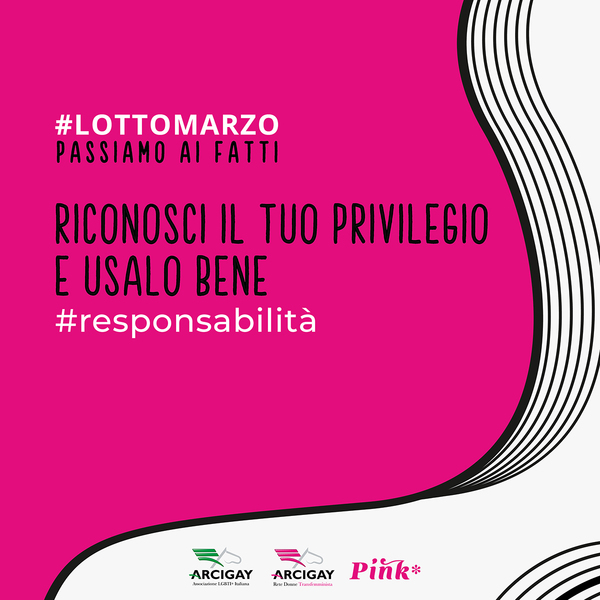
Recognize your privilege and use it well.
What does it mean to have privilege? It means having more choices, not being subjected to discrimination and violence, it means being able to go out in public without fear. The list could go on and on, because privileges and discrimination are infinite. Privilege divides the world into first-class and second-class people; this fact should lead anyone who believes in the ideals of equality, fairness, and justice to fight against privilege. Easy, right? Yet privilege is often invisible to those who possess it. Being transfeminist, therefore, means reflecting on the privileges we may have because of our gender, sexual orientation, our conforming bodies, our ability that corresponds to the expectations of a patriarchal and capitalist society. Being responsible for one's privilege means ensuring it doesn't harm others, renouncing it when possible, or otherwise using it to break down the system that divides us into winners and losers.
#responsibility
@retedonnetransfemminista @Pink.ilgioco

Glitter is like black, it looks good on everything
A specter is haunting Europe: gender! Do you really believe it exists? Like a bogeyman, the idea of a gender theory has spread in recent years. According to those who accept it as fact, it would be imposed as a norm on people, on television and in schools, and through social media where fake news is rampant. But we must ask ourselves who benefits from the invention of gender theory? Who has an interest in keeping people misinformed about what it really means to distinguish between sex and gender, in educating people about respect for diversity in schools, and in adopting good transfeminist practices such as the freedom to self-determination, the desire not to be caged by gender roles and expectations, the challenge of conformity, the rejection of toxic masculinity, and education about affectivity and a positive and conscious sexuality based on consent. "Gender theory" is nothing more than a convenient scarecrow constructed to make it easy to fear. Here's a final good transfeminist practice: going beyond fear and having the courage to imagine a better world where no one is included because no one has the power to exclude anymore.
1TP5Who’s afraid of gender?
@retedonnetransfemminista @Pink.ilgioco