
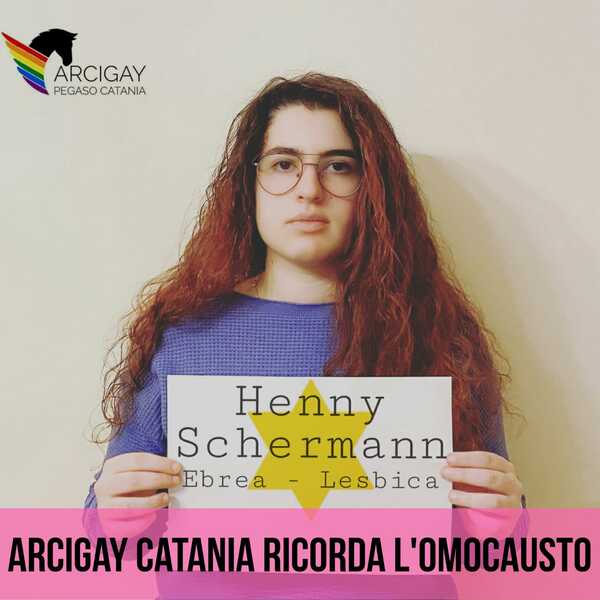
[:it]On Holocaust Remembrance Day 2021, Arcigay Catania remembers the victims of the Nazi holocaust and fascist confinement. The latter hit our city particularly hard.
We wanted to give a voice to the victims, imagining them recounting firsthand the events they witnessed. The following text is therefore fictional, but all the facts narrated are true.
HENNY SCHERMANN
My name is Henny Schermann. I was born in Frankfurt am Main in 1912. I was Jewish and a lesbian. My father, Julius, had emigrated from Russia to Frankfurt, then a major center of commerce, banking, industry, and the arts. My mother, Selma, was originally from the German town of Ober-Ramstadt. I was their firstborn. After me, Herbert and Regina were born. In 1931, after my parents' separation, I ran a shoe shop with my mother. Within a few years, however, all our lives changed.
The Nazi rise to power in 1933 brought a campaign of repression, not only against Jews, Gypsies, disabled people, and political opponents, but also against homosexuals. This ended a period of freedom during which gay and lesbian associations, newspapers, and meeting places such as bars and clubs had emerged. The life of the homosexual community was wiped out within a matter of weeks.
The Nazis created a climate of fear by encouraging police raids and denunciations of lesbians. Many of us went into hiding, some moved to new cities where they would remain unknown, others entered into covert marriages with homosexual friends. It wasn't for me. I continued to secretly frequent the few remaining lesbian clubs in Frankfurt, albeit illegally.
My sister Regina, due to the Nuremberg racial laws, could not marry her partner because he was not Jewish, nor could he recognize my nephew, his son.
After continuous anti-Semitic boycotts we were forced to close the shoe shop, so from 1935 I went to work as a sales assistant for others.
In 1938, a Nazi ordinance decreed that "Sara" had to be added to the name of all Jewish women in official documents, so as to identify us more quickly. But I never did.
In March 1940, I was arrested and deported to the Ravensbrück women's concentration camp because I was Jewish and a "very active lesbian." On the back of my mugshot was written: "Henny Sara Schermann, born February 12, 1912, in Frankfurt, single, shop assistant. Licentious lesbian, frequenter of homosexual bars, did not adopt the name 'Sara'. Stateless Jew.".
On my uniform they pinned a Star of David, made up of two yellow triangles purposely superimposed, which identified Jewish prisoners like me.
In 1942 I was sent to the psychiatric hospital in Bernburg, near Magdeburg, where I was killed in a gas chamber on May 30, 1942.
The Nazis believed that we women were inferior to men and naturally dependent on them. The role of women (especially Aryan women) was to procreate, take care of the house, and raise children—all tasks that even lesbians could be forced to do without being openly persecuted. We counted for nothing, and so, according to some, it didn't matter to persecute us.
Furthermore, from the Nazi perspective, we lesbians were fewer in number than male homosexuals, generally more discreet, did not threaten the purity of German blood, and were more difficult to track down because our displays of affection toward other women could be mistaken for simple gestures of friendship. All these reasons led to our persecution being more limited and less visible and recognizable.
Paragraph 175 of the German Penal Code criminalized only homosexual acts between males, while it did not apply to lesbians (the only country that criminalized lesbianism was Austria).
Lesbians were thus deported to concentration camps for various reasons and charges, such as being Jewish (Star of David), political prisoners (Red Triangle), many as asocial (Black Triangle), etc. Many others were subjected to re-education programs in psychiatric centers.
Since May 9, 2010, four "Stolpersteine" (Stumbling Stones) have honored the memory of Henny Schermann, her mother Selma, her sister Regina, and her brother Herbert in Frankfurt. A family completely exterminated by the Nazi horrors.
Selma and Regina were deported to the Lodz concentration camp in 1941 and murdered there. Herbert emigrated to France, but in 1941 he was arrested in Paris and deported to Auschwitz, where he died of a heart attack in 1942. Julius and his nephew (Herbert's son) were arrested in Paris in 1944, imprisoned in Auxerre, and later liberated by the Allies. Sometime later, in 1948, Julius died from the trauma he suffered during the persecution.
Regina's son was saved by his paternal grandparents who hid him and then at the end of the war his father was finally able to recognize him.
Author: Fabio Cardile
Editing: Vera Navarria
Graphic design: Daniele Russo
Sources:
– United States Holocaust Memorial Museum
– AMIS (Association for the Museum of Intolerance and Extermination).
– “Lesbian R/existences in Nazi-Fascist Europe,” edited by Paola Guazzo, Ines Rieder, Vincenza Scuderi, Ombre corte, 2010.
– Wikipedia.
– Stadt Frankfur am Main (website of the City of Frankfurt am Main).
– Constellations Brisees (a participatory, digital, and feminist European project).
[:]