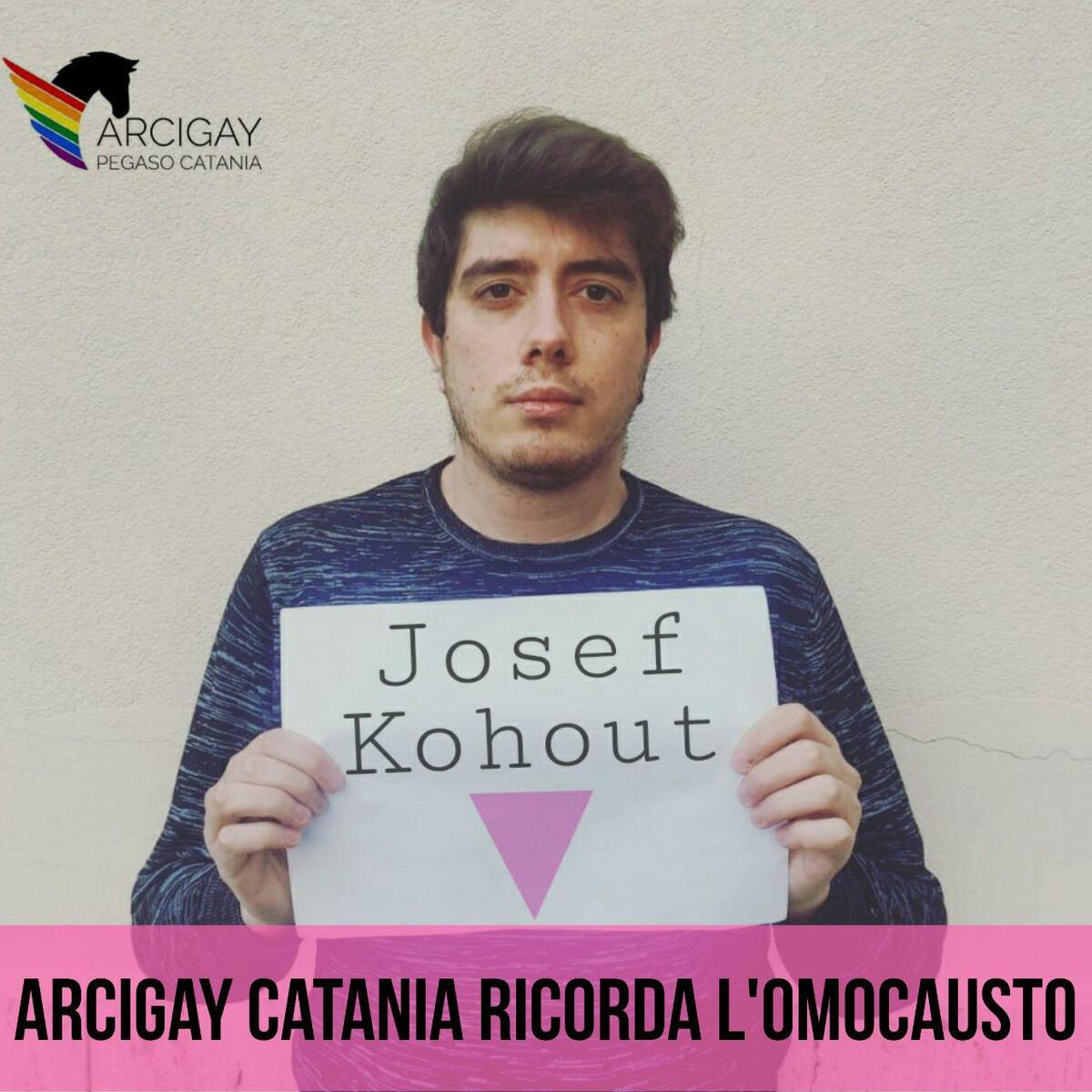
[:it]On Holocaust Remembrance Day 2021, Arcigay Catania remembers the victims of the Nazi holocaust and fascist confinement. The latter hit our city particularly hard.
We wanted to give a voice to the victims, imagining them recounting firsthand the events they witnessed. The following text is therefore fictional, but all the facts narrated are true.
My name is Josef Kohout. I was born in Vienna in 1915 into a Catholic family. I was a university student. When I confessed to my mother that I was homosexual, she said to me: "My dear son [...] If you believe you can find happiness with another man, that doesn't make you mediocre in any way [...] You have no reason to despair [...] Remember, no matter what happens, you are my son and you can always come to me with your problems." Those were the most beautiful words I had ever wished to hear.
In 1938, after Austria was annexed by Germany, German laws were aggressively enforced. The Nazi regime considered homosexuality a threat to the racial health of the Reich and its demographic policies, which included increasing the Aryan birth rate.
On April 13, 1939, I was arrested for "homosexual activity," as my sexual orientation was defined by Section 175 of the German Penal Code, similar to the Austrian statute. According to Section 175, updated in 1935, any indication of homosexuality was sufficient for arrest: gossip, kisses, and letters were accepted as evidence. They intercepted a Christmas card in which I had written: "To my friend Fred in eternal love and deepest affection." Fred, the son of a Nazi leader, unlike me, was not arrested, but acquitted on the grounds of "mental confusion.".
During the Nazi regime, the police had the power to imprison, without trial, anyone they wanted, including those deemed dangerous to racial morality. Approximately 100,000 gay men were arrested, 50,000 of whom were imprisoned. Estimates of homosexual inmates in concentration camps range between 5,000 and 15,000 men. These prisoners were marked with a pink triangle and were among the most mistreated groups in the camps, assigned to the hardest labor. The Nazis, interested in finding a "cure" for homosexuality, conducted experiments on us homosexuals that caused illness, mutilation, and even death, and yielded no scientific knowledge.
After serving my sentence, I was not released, but in December I was transferred to the Sachsenhausen concentration camp, known as the Auschwitz of homosexuals, in Germany, near Berlin. We had to abide by several rules: we couldn't speak to prisoners in other blocks, and we always had to sleep with our hands out of the blankets despite the extreme cold. We were assigned heavy labor, such as shoveling snow with our bare hands, to improve our virile nature. I served as forced labor in the Klinker brick factory. Prisoners who hadn't been beaten to death could easily be killed by the heavy carts that rolled down the steep slopes of the clay pits.
In January 1940, I was transferred to the Flossenbürg concentration camp, near the Czech border in Bavaria. There, I received the identification number 1896 and the pink triangle used to identify homosexual prisoners. I was assigned to Block 6.
On Christmas Eve 1941, I was forced to sing Christmas carols, along with other prisoners, in front of a large decorated tree on the parade ground. Nearby were gallows with eight Russian prisoners hanging from them since morning. That image has remained indelible in my memory, and every time I hear a Christmas carol, I can't help but be transported back to that nightmare.
In 1942 I became a “kapo” in the munitions factory (I was the only homosexual kapo in history).
From the summer of 1943, I and other "Aryan" homosexuals were forced to regularly visit the camp brothel, staffed by "Aryan" inmates forced into prostitution. This was part of a sexual re-education program ordered by SS commander Heinrich Himmler.
On April 20, 1945, as American troops approached the camp, the SS began forced evacuations. I began a death march toward Dachau, but fortunately, on April 25, I was liberated by American soldiers near Cham, about 45 miles from the camp. On the return trip to Vienna, I purchased civilian clothes, but before destroying my filthy uniform, I tore off my identification number (including the triangle) to keep it as a memento of those terrible experiences.
In October 1945, I was granted exemption from work and military service. In 1946, I began a relationship with Wilhelm Kroepfl. In 1948, I applied for the annulment of the criminal charges for which I had been imprisoned. My application was successful, but I was denied financial compensation, and the years spent in concentration camps were even deducted from my pension. I was, however, very fortunate, as homosexuality remained a crime in West Germany until 1969, and some survivors were even imprisoned again. This is also why many never spoke out.
In 1972, I told my terrible story to a friend, and a memoir was published under the pseudonym "Heinz Heger": The Men with the Pink Triangle. It was the first direct testimony from a gay concentration camp survivor. As you can imagine, my efforts to tell my story had a huge impact within the LGBT community, and the book was translated into numerous languages. I had introduced the world to pink triangles. The emotional impact of this work helped break the "conspiracy of silence" surrounding my brothers.
It was not until the mid-1990s that Germany formally recognized homosexual survivors as victims of the Nazi regime.
I died in Vienna on March 15, 1994, at the age of 79. My partner Wilhelm Kroepfl died in 2012.
That pink triangle I tore from his uniform is the only example of its kind belonging to a homosexual prisoner who has not remained anonymous, and today it is preserved, along with other documents of mine, at the United States Holocaust Memorial Museum in Washington.
Author: Fabio Cardile
Editing: Vera Navarria
Graphic design: Daniele Russo
Sources:
United States Holocaust Memorial Museum.
“Personalizing Nazis' Homosexual Victims’ published by ”The New York Times“ on June 26, 1995.
Wikipedia.[:]