
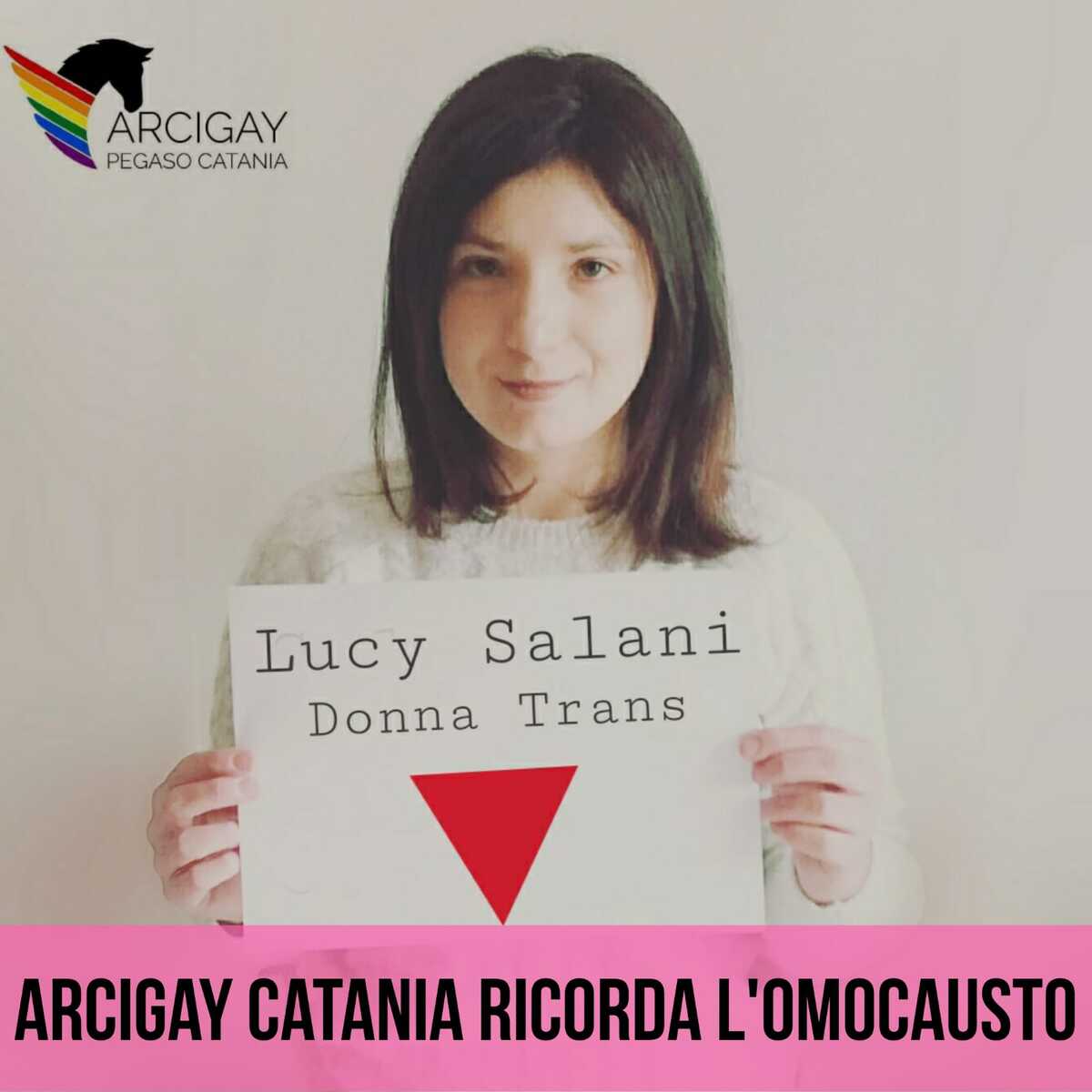
[:en]On Holocaust Remembrance Day 2021, Arcigay Catania remembers the victims of the Nazi holocaust and fascist confinement. The latter hit our city particularly hard.
In the following text, all italicized parts are authentic statements by Lucy Salani. Our interventions, minimal, are in roman type.
LUCY SALANI
My name is Lucy Salani. I was born in 1924 in Fossano to an anti-fascist family of Emilian origin. I am an Italian transgender woman who survived the Nazi concentration camps. I am almost 97 years old.
I've always felt like a girl since I was little. My mother was desperate. I always wanted to do what little girls did at that age: cook, clean, and play with dolls..
My father and brothers didn't accept me. In the 1930s, my parents moved to the Bologna area, and that's how I made friends with several homosexuals in the city.
Back then, homosexuality wasn't talked about, it wasn't supposed to attract too much attention. Fascist gangs, wherever they found people like us, always got into trouble, beating people, shaving them, smearing them with tar... I wasn't expecting war. When you're young, you don't think much about what might come. I was called up. I got the postcard, but I didn't expect it so soon. They called me up when I was 19 and sent me up north. And that's where I started doing my military service. It was tough. I told them who I was, but they didn't believe me. I said: I'm gay. And they said: 'Yeah, they all say that, go, go...' They didn't believe me! But it didn't last long... On September 8th, the army disbanded and everyone tried to return home, each as they could. From the province of Udine, I walked back to Bologna. My parents had been evacuated to Mirandola because of the bombings. I didn't stay long in Mirandola because my parents were afraid they'd catch me, so they sent me to my father's brother in the countryside. I thought I'd be safe with my uncle. After 15 days, both the fascists and the Germans arrived. I was hiding with another boy, but I didn't know him. They stopped us, put us in jail, and interrogated us. For every answer they considered incorrect, we got beaten up! They beat that poor guy. As for me, I told them who I was anyway... They told me: 'Either you go with the Germans or the fascists.' I didn't want either. I definitely didn't go with the fascists; my father spent three years in internal exile because of the fascists. So we went with the Germans. The Germans taught us how to shoot down planes, but I didn't want to be with the Germans, so I threw myself into the freezing water and caught a nasty case of bronchitis. They admitted me to the hospital, and I took off. Besides escaping the Italian army, escaping the hospital, and escaping the Germans, in short, I felt hunted. I was a deserter. And what could I do? I lived by my wits. I was a hustler... One time, a German showed up. We went to the Albergo Bologna. A hefty sum, 50-60,000 lire. As soon as we got upstairs, a squad arrived. They told him to "run!" and they stopped me. And what could I do? They figured out who I was, that I was in Suviana and that I was a deserter. While awaiting trial, they took me to the cellar of a building in Padua. I realized the lock was faulty and managed to escape during the night, once again. But where could I go? After a while, they arrested me again. It was a tragedy. They took me straight to jail. They tried me and sentenced me to death. They took me to the prison in Modena. I asked Kesserling for clemency, and he granted it, but they took me to Germany... First they took me to prison and then to a labor camp. I worked in a factory where I made bomb parts. But I was a fugitive, yes, and I escaped again, with a friend. We wanted to return to Italy and had taken a train, but it was the wrong train, and instead of returning to Italy, we ended up in Berlin. We didn't know where to go. Poor us! We knew a train was about to leave for Innsbruck. We had a hell of a time, but we managed to get to Innsbruck. There, we slept in a hut. We were starving, and it was winter. Bitterly cold... At a certain point, they found us, we were at the station, and my friend said to me, 'Lucy, I'm running, I'm running away.' I told him, 'No, don't do it, don't do it.' He got off the train and started running. The soldiers chased him and shot him. There. Dead. They left him there, no one bothered to look at him… I remember entering the Dachau concentration camp. They made us strip and with a bin they did what they called disinfestation, and after a while our skin was coming off. Upon leaving, I saw a horrifying scene: a prisoner was strangling a young boy to get an extra piece of bread… Their names no longer existed, only the number we had to repeat in German. We were dying every day, and initially, since we were new, they made us carry the bodies to a mass grave around the camp with lots of pre-dug holes: it was truly humiliating. Then they said that if we wanted to work, they'd give us an extra piece of bread, and so in the morning they'd load us onto a train and take us to Munich to lay the tracks, because it was a period of constant bombing… What I saw in the camp was terrifying. Dante's Inferno is a walk in the park compared to that. Hang them. People dying on the streets. People who were just skin and bones. They were experimenting. They burned the dead, and some were still alive, moving through the flames. Terrible, terrible. In the morning, when you woke up and looked around the electrified fence, you'd find a pile of kids tied up. You could see the flames coming out of these kids' bodies. The smell... Luckily, I was a deserter, not homosexual. I stayed in that camp for six months, and the day the Germans realized it was over, they piled us up in the center of the camp and started shooting. I was wounded in the leg and fainted, and the Americans found me among the corpses... And so I returned home to Italy. When my mother saw me, she fainted. She thought I was dead, shot. It was a beautiful celebration, yes. And when I think about it, I still don't know how I survived all that. It was torture... No one wanted to know when I returned. No one ever asked me what happened to me in Dachau. We were forgotten. People didn't care. They didn't want to know, they didn't want to know... I had some wonderful times in Turin. I worked as an upholsterer. I went to clubs. I was happy. I was loved. I had friends. I had so much fun in Turin. First I was with one, then another, and so on, but always with just one. I love one, even if I was with the others... I've already been back to Dachau three times since the liberation, and every time I feel a feeling I can't describe. I'm blocked and tears keep flowing... It's impossible to forget and forgive. Some nights I still dream of the most horrendous things I've seen, and I feel like I'm still in there, and that's why I want people to know what happened in the concentration camps so it never happens again.
Lucy was one of the first Italians to undergo gender reassignment surgery in London in 1982, but was unable to change her identity documents. This continues to be a source of discrimination today, particularly when she was refused admission to a nursing home in 2018.
Author: Fabio Cardile
Editing: Vera Navarria
Graphic design: Daniele Russo
Sources:
– “The Testimony of Lucy, the Transgender Survivor of Dachau” by Anas Chariai, published in “Il Grande Colibrì” on 01/27/2018.
– “Lucy, a homosexual in Dachau «Being a deserter saved me»” by Davide Bonesi, published in “la Nuova Ferrara” on 01/28/2018.
– “Lucy Salani: 'I want people to know what happened in Dachau so it never happens again'‘ by Mattia Vallieri, published on ’estense.com” on 01/29/2018.
– “Holocaust, the 'Pink Triangles' and the Forgotten Extermination‘ by Maria Teresa Martinengo, published in ’La Stampa” on January 24, 2018
– Wikipedia.
[:]