[:en]Here is another episode of our column Night-night, America of our member Alessandro Casiraghi.
Columbus
In 1992 I was in elementary school. I have little memory of what I was taught about Columbus at the time. But I remember perfectly that that year Esso was giving away a dish to celebrate the 500th anniversary of the discovery of America. When my parents ordered pizza on the weekends, I used that plate to eat it. As I devoured the slices, the navigator's imposing face gradually emerged, albeit stained with tomato sauce. I couldn't have a more pleasant memory of Columbus, my pizza-eating companion.
That's why I was shocked when, in 2018, a few days after arriving in America, I was told that they wanted to remove his statue in Manhattan.
“How?” I asked. “For what reason?”
“Because he killed a lot of natives!”
I didn't understand. And I let it go, without commenting further. Columbus couldn't have been a murderer. It was surely a mistake, based on some fake news I hadn't yet heard of. Or—I told myself—Columbus had become the scapegoat for all those explorers who, after him, colonized the New World with less valiant motivations than his.
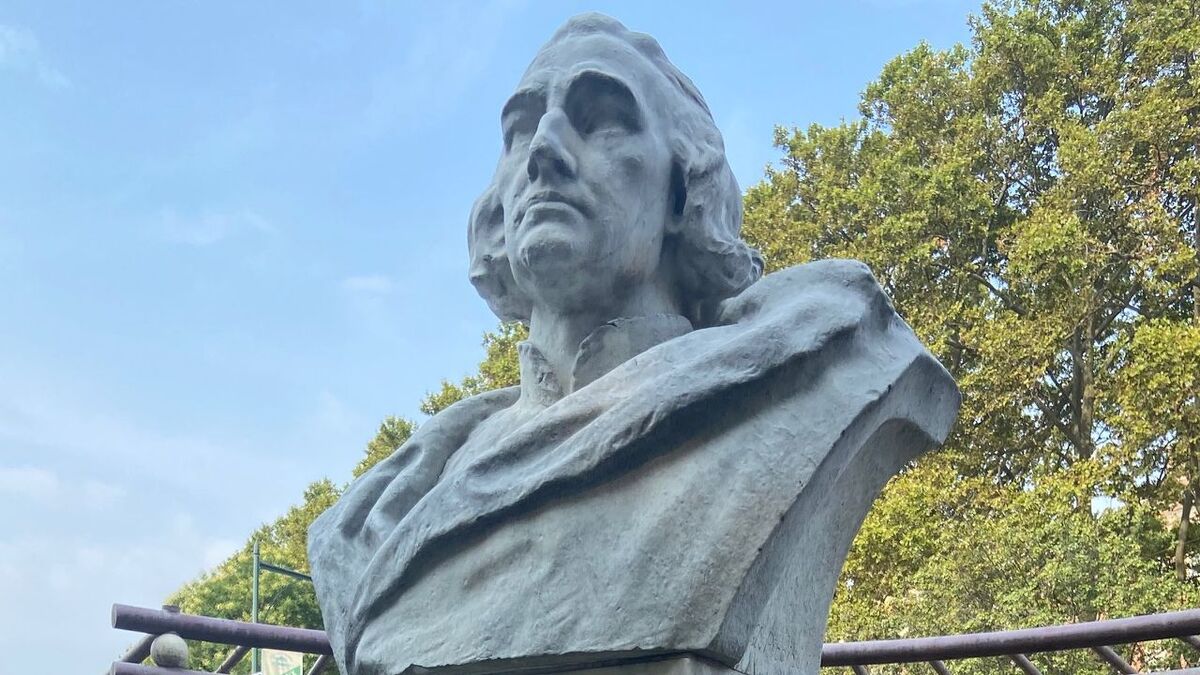
I let it go, until the statues started really knocking them down, in London, America and around the world. After the death of George Floyd, anti-racism protests erupted in several cities calling for the tearing down of statues of figures from American history – ancient and recent – accused of racism, slavery, and abuse against African Americans and minorities. On June 26, 2020, Trump issued a executive order which, among other things, reduced financial transfers to police districts that failed to protect monuments. Columbus Circle, the roundabout at the entrance to Central Park, where there is a tall column topped by a statue of Columbus, the police presence had doubled. Even in a small park of a few dozen meters on Arthur's Avenue, the Little Italy of the Bronx, the bust of Columbus was guarded by a police car. Since August, this bust has been the subject of a petition and one demonstration for its removal.
That's why I decided to question my childhood memories by reading the biography of Christopher Columbus on Wikipedia. And that's how I discovered its two faces.
On one side, the dreamer obsessed with finding an alternative route to the Indies. The navigator who knocked on the doors of half of Europe's royal families to finance his enterprise (and finally convinced the Spanish). The commander who quelled an attempted mutiny among his crew just two days before discovering the new "Land!". The merchant who gave his name to the "“Columbian Exchange”", the largest exchange of plants, animals, cultures, human populations, technologies, diseases, and ideas that took place between the Americas, Africa, and Europe between the 15th and 16th centuries. The hero to whom streets, squares, cities, and nations have been named. As well as Columbus Day, an American national holiday since 1934, celebrated on the second Monday of October and over time becoming the celebration of the Italian-American community.
On the other hand, the man who brought disease and violence to the New World. The conqueror who established his colony. Hispaniola, and then shared it with his brothers. The merchant who enslaved the natives, sparing them from mutilation only if they brought gold. The spokesman for the Catholic religion who forced the natives to convert through the practice of request. The punisher who used such bloodthirsty methods that he forced the Spanish royals to strip him of the title of Viceroy and Governor of the Indies.
The Catholic priest Bartolomé de Las Casas, who documented what was happening in the territories ruled by Columbus, wrote in his memoirs that the Spanish "killed, terrorized, and tortured the indigenous populations" with "new, strange, and more varied methods of cruelty," and that this systematic violence was aimed at preventing the natives from considering themselves human beings. David E. Stannard, an American historian and professor at the University of Hawaii, and the author of "“American Holocaust“estimates that over the thirty years following Columbus's landing, due to the combined effects of disease and violence, Hispaniola's population declined from 8 million to near extinction. Stannard describes Columbus thus: “He also had such intolerance and contempt for anything that didn't look and act like him, for anyone who didn't believe what he believed, that he thought it acceptable to imprison, enslave, and kill people who weren't like him. He was the secular personification of what more than a thousand years of Christian culture had created.”.
When I finished reading, I was confused. I was stunned by the story of such a complex character. The story of a man who had desperately wanted to discover a new world, and who had then chosen force and violence as his first course of action to manage it. I was confused because since childhood I had been portrayed as a heroic figure, and now I found myself also dealing with a murderer. I was angry because I realized more concretely that I had lived on the privileged side of history, on the side of the Europeans, the colonialists, the whites.
If, after more than five hundred years, we still debate the meaning of that landing, it's because we have violated our collective memory. We preferred to pass on the story of a hero rather than confront the atrocities he committed.
In 1990, the state of Dakota replaced Columbus Day with Native Americans' Day to honor its diverse indigenous populations. Today, 14 U.S. states celebrate Columbus Day.’Indigenous Peoples' Day in place of or in addition to Columbus Day.
(Photo taken from the following link: https://www.ny1.com/nyc/all-
Alessandro Casiraghi
 [:]