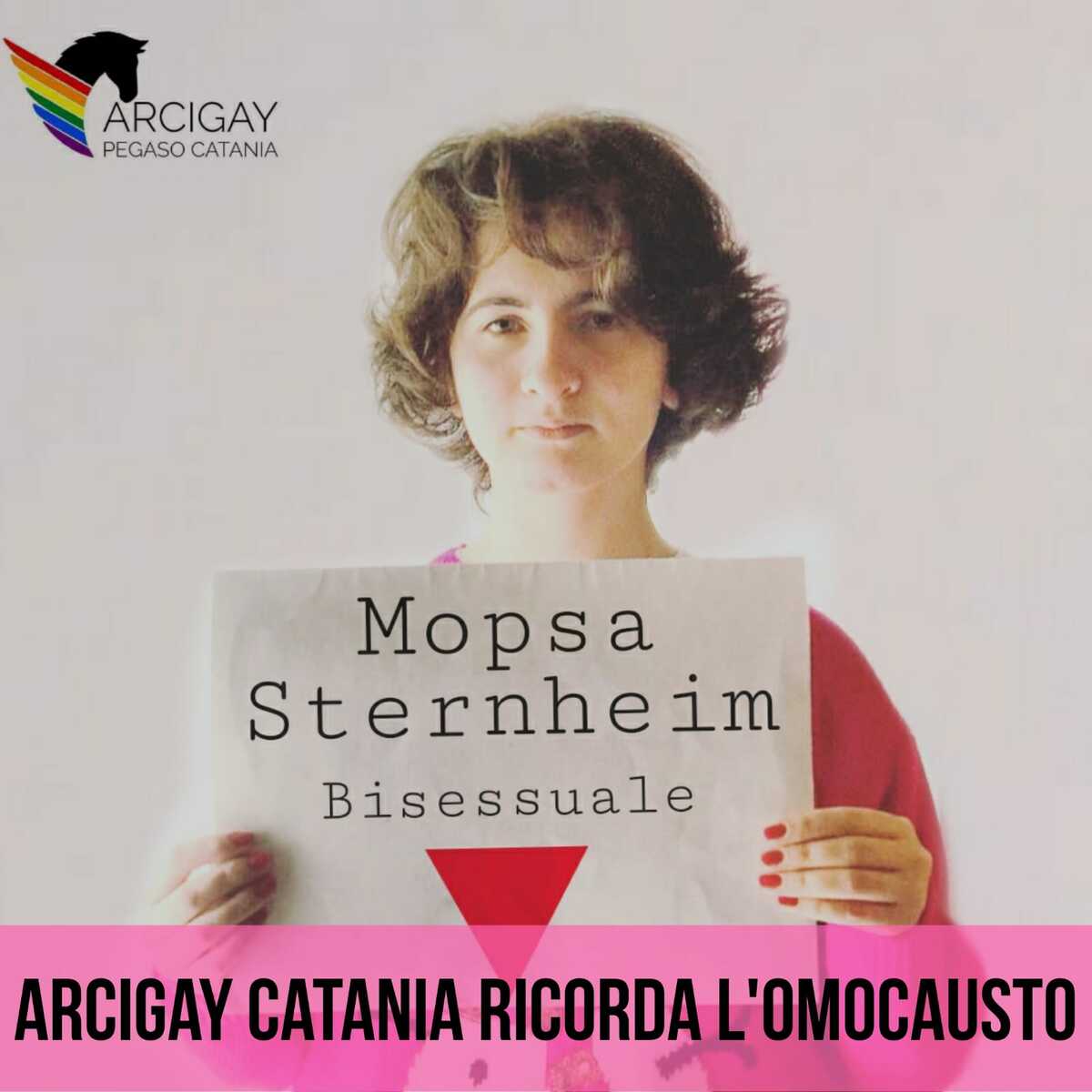
[:it]On Holocaust Remembrance Day 2021, Arcigay Catania remembers the victims of the Nazi holocaust and fascist confinement. The latter hit our city particularly hard.
We wanted to give a voice to the victims, imagining them recounting firsthand the events they experienced. The following text is therefore fictional, but all the facts narrated are true.
MOPSA STERNHEIM
My name is Mopsa Sternheim. I was born in 1905 in Oberkassel, near Düsseldorf, Germany. I am bisexual. I have been a set and costume designer, but I am best remembered as a German resistance fighter in France.
My real name is actually "Elisabeth Dorothea Löwenstein," but I've always been called Mopsa. At 11, I had the first shock of my life: I discovered that my father was not the lawyer Arthur Löwenstein, my mother's husband, but the Jewish writer Carl Sternheim, first the lover and then, from 1907, the second husband of my mother, the writer Thea Bauer. I was very close to my father, Arthur, with whom I lived until 1912, when he remarried.
In 1913, I went to live with my mother, my biological father, and my little brother Klaus. We spent the years of the First World War in the Netherlands, which was neutral, then briefly in Switzerland, and finally in 1922 we returned to Germany, to a small town near Dresden. From that period, I remember my interest in politics, which had developed at the age of 13, my reading of Kleist, Dostoevsky, Tolstoy, and Schiller, my friends in the literary world, and my parents' communist comrades, among whom stood out the figure of the Soviet trade union secretary Helene Lerner, whom I greatly admired because she embodied my ideal of a free person. However, those were also terrible years, during which I had to quickly learn to defend myself from my father's sexual abuse. My parents argued often over this, and there was always an air of tension in the house. My mother fell into depression and attempted suicide.
In 1923, I enrolled at the Dresden Academy of Art. I often felt out of place, an outsider. I was attracted to some of the young women there, but I couldn't talk to them. The following year, I began an apprenticeship as a costume and set designer at the Cologne Theater, and then in 1926 I moved to Berlin. During that period, I had several relationships with both women and men and developed strong friendships, particularly with Klaus Mann, with whom I shared the same political views, a large circle of gay and lesbian friends, and, alas, a penchant for drugs. After a motorcycle accident, in fact, I had taken a painkiller and then switched to morphine, and thus began my addiction. In 1928, I met the homosexual French writer René Crevel, who became one of my best friends, so when he committed suicide in 1935, it was a terrible blow for me.
In 1929, I fell in love with Rudolph von Ripper, an Austrian painter and illustrator, whom I married that same year. After our marriage, I obtained Austrian citizenship. Meanwhile, my mother, who had divorced my father, moved to Paris in the winter of 1931.
In 1933, disgusted by the appearance of the Nazis in Berlin, I too moved to Paris, which had quickly become a hub of German anti-Nazi activity, thanks to many left-wing refugees like myself from Germany. I helped produce the "Brown Book," which denounced Nazi crimes. My husband handled its distribution in Berlin, but was immediately arrested and deported to the Oranienburg concentration camp for six months. When he was released, he drew a series about the hell he experienced in that camp, and I took care of distributing it, but almost no one believed those accounts. From 1935, thanks to my friendship with Eddy Sackville-West, cousin of the famous Vita, I had the opportunity to publish articles on anti-Nazi activities in the Manchester "Guardian.".
In 1939, I returned to live with my mother because I was no longer able to support myself financially, as my husband had moved to the United States. In 1941, I was stripped of my German citizenship* and declared stateless, making life even more difficult in German-occupied France.
In early 1943, I joined the French section of the British Resistance group SOE (Special Operations Executive) to help my French friend Michel Zimmermann, persecuted as a Jew, escape to England. On December 2, 1943, I was arrested by the Nazis and taken to Fresnes prison where they tortured me. They knocked out my teeth to force me to reveal what I knew about the Resistance and the names of other SOE agents, but they achieved nothing. On January 24, 1944, I was transferred to Compiègne, a concentration camp north of Paris, and a few days later deported to Ravensbrück in Northern Germany. My papers were stamped with the initials R.ü. (Rückkehr unerwünscht: Unwanted Return).
Upon arrival, they made me undress, shower, undergo a medical check, and finally give me the clothes marked 27908 and the red triangle for political prisoners. I was assigned to an office job. I had to compile reports on all the prisoners: there was a register for every arrival and departure, one for criminals, and others listing all the tasks performed by the inmates. Later, thanks to the fact that I spoke both German and excellent French, I was able to become head of the Infirmary Block, which housed many political prisoners, especially French, suffering from typhus, scarlet fever, and dysentery. Everyone, including the SS, tried to stay away from that block for fear of infection. This allowed me to transform it into a hiding place for women on the transport list or on the list for the gas chamber. I also tried to give a modicum of dignity to the dying patients, providing them with extra food rations or some medicine to ease their pain. However, when the Nazis noticed my attention to the sick, they sent me to work in some factories inside the camp that were producing war weapons.
A few months later, on April 23, 1945, I was liberated by the International Red Cross and taken to Sweden. I owe everything to my fellow prisoners. These transports were divided by nationality, so if they hadn't included me in the French group, I don't know how long I would have remained there, given my stateless status.
During my years in the concentration camp, I had a romantic relationship with student Betty George, from whom I perhaps drew the strength to move forward, not to give up, and to help others. On June 26, 1945, when I finally saw my mother after years, Betty was with me. But after some time, our relationship ended.
In 1948 I returned to Germany for the first time, where it was very rewarding to testify in the trial of the Ravensbrück camp staff.
On September 11, 1954, I died of cancer. A few months earlier, in the diary I began at age 13 and which stayed with me throughout my life, I had written the words with which I leave you:
“Always the same mistake: when they arrest you, you think: it's over; when you arrive at the concentration camp, you think: it's over; cancer: it's over. No, it's NEVER over until you die. The rest is just ideas.”
Author: Fabio Cardile
Editing: Vera Navarria
Graphic design: Daniele Russo
Sources:
- “Lesbian R/esistences in Nazi-Fascist Europe,” edited by Paola Guazzo, Ines Rieder, Vincenza Scuderi, Ombre corte, 2010.
- FemBio Frauen-Biographieforschung (German feminist encyclopedia of women's biographies).
Note:
*Second Germany-Visa.org In August 2021, changes were made that allow descendants of Nazi victims to obtain German citizenship. For more information, please consult the following link: https://www.germany-visa.org/german-citizenship/by-descent/ (German Citizenship by Descent & Ancestry).
 [:]
[:]