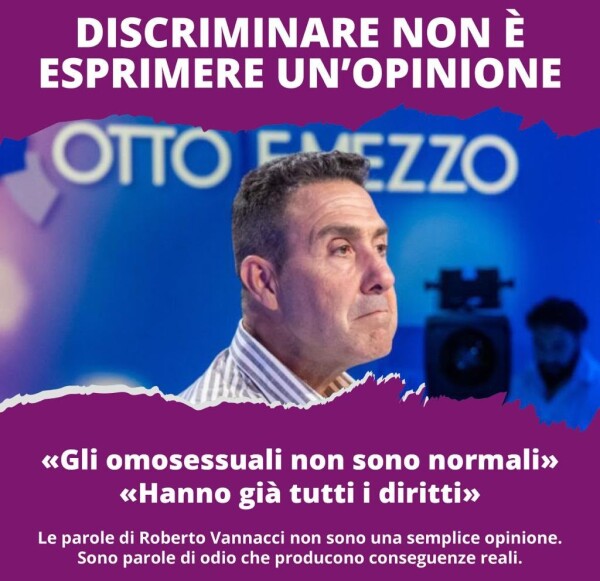
Discrimination is not expressing an opinion: why Vannacci's words cannot be normalized
«Homosexuals are not normal» and «they already have all the rights.».
Statements made by Roberto Vannacci during the broadcast Eight and a Half They cannot be dismissed as mere personal opinions or as provocations intended to fuel public debate.
These are statements that contribute to building and reinforcing a social stigma against lesbian, gay, bisexual, transgender, non-binary, queer, intersex, and asexual people.
Words are not neutral. They have devastating consequences. When they are uttered by highly visible public figures with political responsibilities and amplified on television, they are hateful propaganda that contributes to legitimizing the prejudices, exclusions, and discrimination that thousands of people experience every day.
Defining a segment of the population – LGBTQIA+* and queer people – as “non-normal” means drawing a symbolic boundary between those who are fully entitled to be part of society and those who, instead, are labeled as different, inferior, and therefore less worthy of social recognition.
But if by “non-normality” we mean “non-conformity to imposed norms” then we claim the fact of not being as patriarchal society imposes us to be.
We're told that discrimination against our community doesn't exist. Yet, reality tells a very different story than Vannacci describes.
On the occasion of the International Day Against Homolesbobitransphobia, Arcigay presented its 2026 Report on hate and discrimination against LGBTQIA+ people, symbols, and places reported by the Italian media over the past twelve months. A total of 127 incidents of violence, aggression, discrimination, and vandalism were recorded. This number paints a picture of a country where hatred is not an exception, but a constant presence in the daily lives of those who do not conform to gender and sexual orientation stereotypes.
Among the most alarming data is the phenomenon of assaults via dating apps. At least fourteen documented incidents involve people lured through chat rooms and dating apps, only to be robbed, beaten, blackmailed, or extorted. In Treviso, a 42-year-old man was brutally attacked after a date arranged online. Cases of serial assaults have emerged in Bergamo and Caserta. In Padua and Rovigo, gay men were approached in their homes and robbed. In Alessandria, a transgender woman was lured via an app, robbed, and killed.
The report also documents ongoing attacks on symbols and spaces of the LGBTQIA+ community: vandalized rainbow benches, targeted association headquarters, and attacks on gathering places. It also recounts dramatic stories of isolation and suffering, including cases of suicide, profoundly questioning the collective responsibility of a society that continues to marginalize those perceived as different.
Therefore, the problem isn't the lexical meaning of the word "normal." The problem is its political and social use. When a political leader publicly declares that homosexual and transgender people are abnormal, he isn't reporting a statistic: he's making a value judgment. He's asserting that there is a majority considered legitimate and a minority that isn't worthy of recognition.
Article 3 of the Italian Constitution states that all people have equal social dignity and are equal before the law. There are no "normal" citizens and less normal citizens. There are no lives more dignified and lives less worthy of respect. The Republic is called to remove the obstacles that limit freedom and equality, not to reinforce them through narratives that fuel discrimination.
For decades, the international scientific community has clarified that sexual orientation and gender identity are "natural" variations of human behavior, conditions worthy of respect, consideration, and recognition. Homosexuality and transgenderism are not illnesses, they are not deviant behaviors, and they do not represent a state of moral, social, or psychological inferiority compared to heterosexuality and cisgenderism.
This is why we are not dealing with a legitimate difference of opinion on the facts, but with the dissemination of a negative representation of millions of people.
Even the claim that LGBTQIA+ people already have “all rights” doesn’t hold up to reality.
Italy continues to rank among the lowest in Western Europe in terms of recognizing the rights of LGBTQIA+ people. Same-sex families still lack full legislative recognition. Same-sex marriage does not exist. Many protections for the children of same-sex couples have been recognized only thanks to the intervention of the courts and the Constitutional Court, which continue to fill the gaps left by politics.
Transgender people still face complex procedures for document adaptation and do not benefit from streamlined and self-determined administrative procedures as is the case in many European countries. Furthermore, effective protections against discrimination continue to be lacking in various areas of social life, from work to sports, from school to healthcare.
To argue that LGBTQIA+ people already have all the rights they deserve because they can go to school, drive a car, or access a hospital ignores the fundamental issue: the problem isn't just being able to enter those places, but being able to travel through them without being discriminated against, humiliated, or considered second-class citizens.
Many LGBTQIA+ people continue to experience bullying, social exclusion, and family rejection. Many refrain from openly declaring their sexual orientation or gender identity for fear of the consequences. Scientific literature defines this condition as "minority stress": a set of psychological pressures generated by social stigma that expose LGBTQIA+ people to greater risks of anxiety, depression, isolation, and suicidal thoughts.
Words construct imaginations. Words influence how a society views its minorities. And the words spoken by those in public office carry even greater weight.
Freedom of expression is a fundamental principle of democracy. But freedom of expression cannot be transformed into the freedom to deny equal dignity to others. It cannot become a tool to legitimize discrimination or fuel hostility towards social groups already exposed to marginalization and violence.
For this reason, Arcigay believes it is necessary to reopen a public and political discussion on hate speech and the tools needed to combat it. Many European countries have adopted advanced legislation to prevent discrimination and combat hate speech against LGBTQIA+ people. Italy, however, continues to lag behind.
We don't ask for privileges. We demand that no one be considered inferior, wrong, or less worthy of respect because of their sexual orientation or gender identity. We demand that politicians stop using our lives as a platform for propaganda and that the dignity of LGBTQIA+ people be finally recognized and protected without ambiguity.
Because human rights are not an opinion.
And no democracy can be fully considered such as long as there are those who can arrogate to themselves the right to define a part of its population as "not normal".