

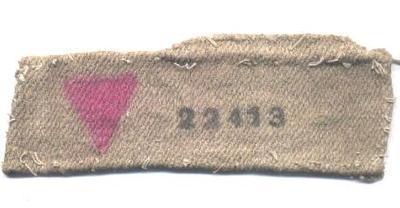
The January 27 This day was designated by the United Nations International Assembly to remember the victims of Nazi-Fascist extermination. Along with Jews, Roma, Sinti, Yenish, and Jehovah's Witnesses, numerous homosexuals were interned in concentration camps during the Third Reich. According to data found in the archives of various concentration camps, courts, and police stations, by 1943, concentration camps had already held 46,436 homosexuals. Men were distinguished from other prisoners by a pink triangle sewn onto their uniforms at chest height; women by a black triangle. Unlike Germany, in Italy, the fascist regime, in replicating Nazi persecution, chose to ignore homosexuality. Based on this policy of silence, the Italian penal code never criminalized homosexuality, leaving its repression to the moral and religious sphere. Should it be necessary to intervene, it was argued, law enforcement already possessed the necessary tools. These tools consisted of three types of measures: a warning (a sort of public warning to abandon "criminal" behavior, under penalty of more severe sanctions), a reprimand (a sort of two-year house arrest), and, above all, confinement, that is, forced residence in a place far from where the person lived, with restrictions on personal freedom.
Confinement meant separation from relatives, friends, and companions, but also public condemnation and social ostracism. Arrest brought with it traumatic consequences: many relatives refused to have contact with those confined for homosexuality; victims of a mentality in which homosexuality was an unforgivable sin, homosexuals themselves suffered from it. dishonor thrown onto their families. No recognition was granted to homosexual former internees at the end of the war. Some of them applied for pensions as former internees. However, nothing was recorded in their files, where only a code number indicated their true status. None succeeded in obtaining it, just as none succeeded in obtaining rehabilitation from the state.
On the occasion of Holocaust Remembrance Day, several Arcigay clubs are launching initiatives to spread the memory of the Holocaust. Udine, for example, the Territorial Committee Arcigay Friuli Nuovi Passi will meet at 7.15 pm in Piazzetta Lionello (in front of the Udine Municipality) to perform the theatrical performance DISCORSI d'ODIO by the CCFT theatre group, followed by speeches by representatives of Arcigay and Arcilesbica, the mayor of Udine Furio Honsell and the president of ANPI Udine Dino Spanghero. Bologna, At 10 a.m., LGBT associations will participate in the official commemoration of LGBT victims of Nazism and Fascism, in the presence of authorities and institutions at the monument dedicated to them in the Gardens of Villa Cassarini. Throughout the day, bookmarks with pink and black triangles will also be distributed, in memory of gay men and lesbians deported to concentration camps. Rome, at the Gay Center, a caviardage workshop on homosexual victims of Nazi fascism is scheduled from 7 pm. An exhibition on the Holocaust is also on display in the same space until January 31st. Turin,CasArcobaleno hosts two exhibitions dedicated to Holocaust Remembrance Day until January 30th. The first, "Adelmo and the Others – Homosexuals in Confinement in the Matera Region," curated by Cristoforo Magistro, collects documents dating back to the Fascist period, when homosexuals were sent into confinement. The recovered dossiers, containing photographic testimonies not only of homosexuals but also of law enforcement officers, have been catalogued and are being exhibited for the first time in Italy. The second exhibition, Ash pink, curated by Jacopo Campagni and produced by Arcigay Il Cassero of Bologna, brings together the works of nineteen young artists, active in the fields of illustration and comics, who are grappling with the visual narrative of eleven stories of gay men and lesbians persecuted during Nazi-Fascism. On January 27th, at 8:30 pm, CasaArcobaleno will also screen the film Aimée & Jaguar, inspired by the true story of Lilly Wust and her relationship with Felice, a Jewish girl who fought in the Berlin resistance during the end of World War II. Finally, Friday, January 29th at 8:30 p.m. the documentary will be screened The Roses of Ravensbrück – The Story of Italian Deportees, directed by Ambra Laurenzio. A Trento For the first time this year the official celebration of the Municipality's Day of Remembrance will be dedicated to the Holocaust: the January 27th at 5 pm, in the Falconetto Hall of Palazzo Geremia (via Belenzani 20), Giuseppe Ferrandi, director of the Trentino Historical Museum Foundation, will speak about "“The Nazi-Fascist persecution of homosexuality“; Thursday 28 January at 9pm Cinema Astra Multisala (Corso Buonarroti 16) is scheduled to screen the film “Bent” by Sean Mathias. Perugia The meeting "Homosexuals: From Yesterday's Deportation to Today's Denial of Rights" will be held on January 27th at 7:30 p.m., in collaboration with Circolo Arci Island, ANPI Perugia, and ANPI Studentesca UniPG. On January 29th at 9 p.m., the Teatro di Figura Umbro will host a theatrical performance. The fairies of the night. TO Pavia On Monday, February 1st, at 9 p.m. in the Aula del '400, Piazza Leonardo da Vinci, Arcigay Pavia ‘Coming-aut“ and Universigay present ”Memory is me too,“ an evening to pay tribute to each minority, each victim, with the due remembrance. Mantua Friday, February 5th at 9 pm at the Spazio Studio Sant'Orsola (via Bonomi 3), Arcigay la Salamandra of Mantua with ars Creazione e Spettacolo presents “Another memory – a reading to remember”, an educational initiative open to the public aimed at middle and high school students. Genoa The exhibition will remain on display in the Sala Dogana of the Palazzo Ducale until February 7th Rights and Prejudices – Yesterday and Today to edited by Alice Merlo and Valentina Marzi (Tuesday to Sunday, 3pm to 8pm. Free admission).